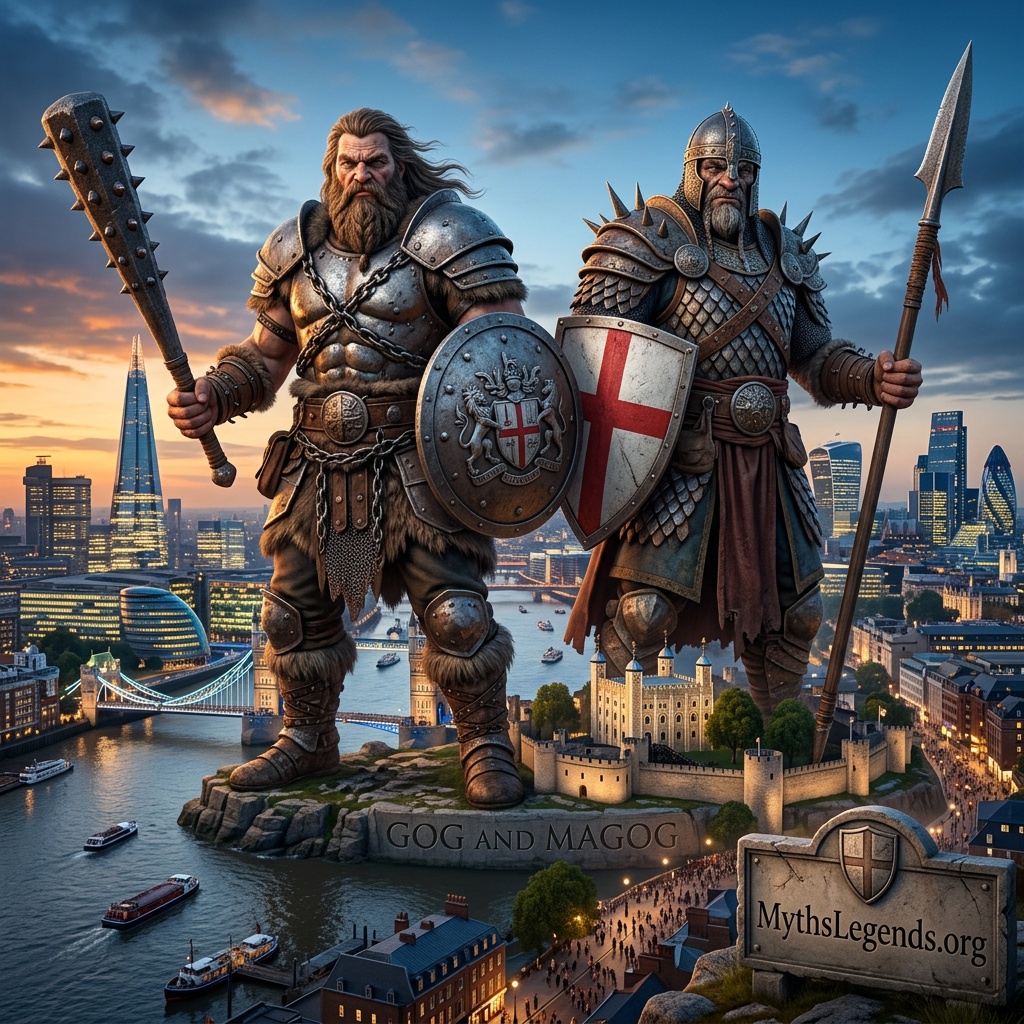
Gog and Magog: Mythical Guardians of the City of London – Legends, Stories, and Their Significance
The history of London is rich in myths, sagas, and fascinating legends. One particularly captivating tale revolves around two gigantic figures known as Gog and Magog. For centuries, these two giants have been regarded as the symbolic guardians of the City of London and are closely linked to the city’s history and traditions. But who are Gog and Magog really? Where do these legends come from, and what significance do they hold today?
Origins and Historical Roots – The legends surrounding Gog and Magog can be traced back to antiquity. Their origins lie in various cultural and religious traditions that have intertwined over the centuries. In Christianity, Gog and Magog first appear in the Bible—more specifically in the Book of Ezekiel and later in the Book of Revelation. There, they are described as hostile forces fighting against God’s people and destined to be defeated at the end of time. Yet the story of the two giants does not have exclusively Christian-religious roots. In Celtic legends and early medieval British chronicles, a connection is drawn between Gog and Magog and the founding of London. One of the best-known accounts is found in Geoffrey of Monmouth’s 12th-century work “Historia Regum Britanniae.” According to this tradition, Brutus, a legendary descendant of the Trojan hero Aeneas, was the founder of London. On his journey to the British mainland, Brutus is said to have encountered the giants Gog and Magog, whom he and his companions eventually defeated and captured. The captured giants were later appointed guardians of his new city.
Gog and Magog: Symbols of the City of London – Over the centuries, Gog and Magog have become an integral part of London’s urban symbolism. Especially in the City of London—the metropolis’s historic and economic center—they are an indispensable part of the city’s traditional ceremonies and festivities. The annual “Lord Mayor’s Show,” a parade celebrating the inauguration of the new Lord Mayor of the City of London, always places Gog and Magog at the center of attention. Since the Middle Ages, the two figures have been part of the procession as giant wooden sculptures and are carried through the streets every year. This depiction recalls their role as mythical defenders and the embodiment of London’s strength and resilience. The figures themselves have been redesigned time and again over the years. While the original depictions were likely linked to Celtic or Anglo-Saxon myths, modern interpretations bear distinct features of medieval and early modern art. Particularly striking is their majestic appearance: Gog and Magog are often depicted with weapons such as clubs or axes, which underscore their strength and protective role.
Their Role in Mythology – Although Gog and Magog are primarily associated with the City of London today, they are also part of a much larger mythical and symbolic tradition. In religious mysticism and literature, they symbolize the struggle between good and evil, chaos and order. Their role extends far beyond local legends: In Islam, for example, Gog and Magog appear under the names “Yajuj” and “Majuj,” two destructive peoples said to one day threaten the world. In many interpretations, Gog and Magog represent the untamable forces of nature that must be overcome and mastered by human heroes. This interpretation also fits their role in London’s mythology: as giants, they represent the primeval, wild forces that threatened the city’s founding, while their later role as protectors of London symbolizes the triumph of civilization and order over chaos.
The Tension Between Myth and Reality – As with many legends, the question arises as to the truth behind Gog and Magog. Historians and archaeologists have found no direct evidence of the giants’ existence, and many details of their story are clearly shaped by literary imagination. Nevertheless, Gog and Magog exert a powerful fascination, as they are not merely figures of the past but also serve as symbols of the City of London’s modern identity. The connection between myth and reality is particularly evident in the city’s cultural heritage. The wooden figures presented at the “Lord Mayor’s Show” may not be real giants, but they embody London’s long tradition and pride. Their presence at public events and in the city’s art tells a story of community, history, and cultural continuity.
Gog and Magog in the Modern Era – Even today, Gog and Magog have lost none of their significance. On the contrary: they are an integral part of the city’s traditions and attract tourists and historians alike. Many travelers wish to see the figures and learn more about the fascinating stories that surround them. Furthermore, Gog and Magog serve as inspiration for art and literature. Numerous contemporary works draw on the legends and reinterpret them, whether in films, books, or art installations. These creative adaptations demonstrate how alive the story of the two giants remains to this day and how it is continually rediscovered and reinterpreted.
The Immortal Guardians of the City of London – The legend of Gog and Magog is a striking example of how myths and legends can shape a city’s identity and history. Although they originally stem from different cultural and religious contexts, the two giants have evolved over the centuries into a central symbol of the City of London. Their stories connect the past with the present, prompting reflection on the role of myths in modern society while also providing material for artistic and creative expression. Gog and Magog are not only guardians of the city but also custodians of a rich tradition and cultural heritage that inspires people worldwide. Thus, the centuries-old legend of Gog and Magog remains alive in our time—a fascinating chapter in London’s history that playfully blurs the boundaries between myth and reality.

Post Comment