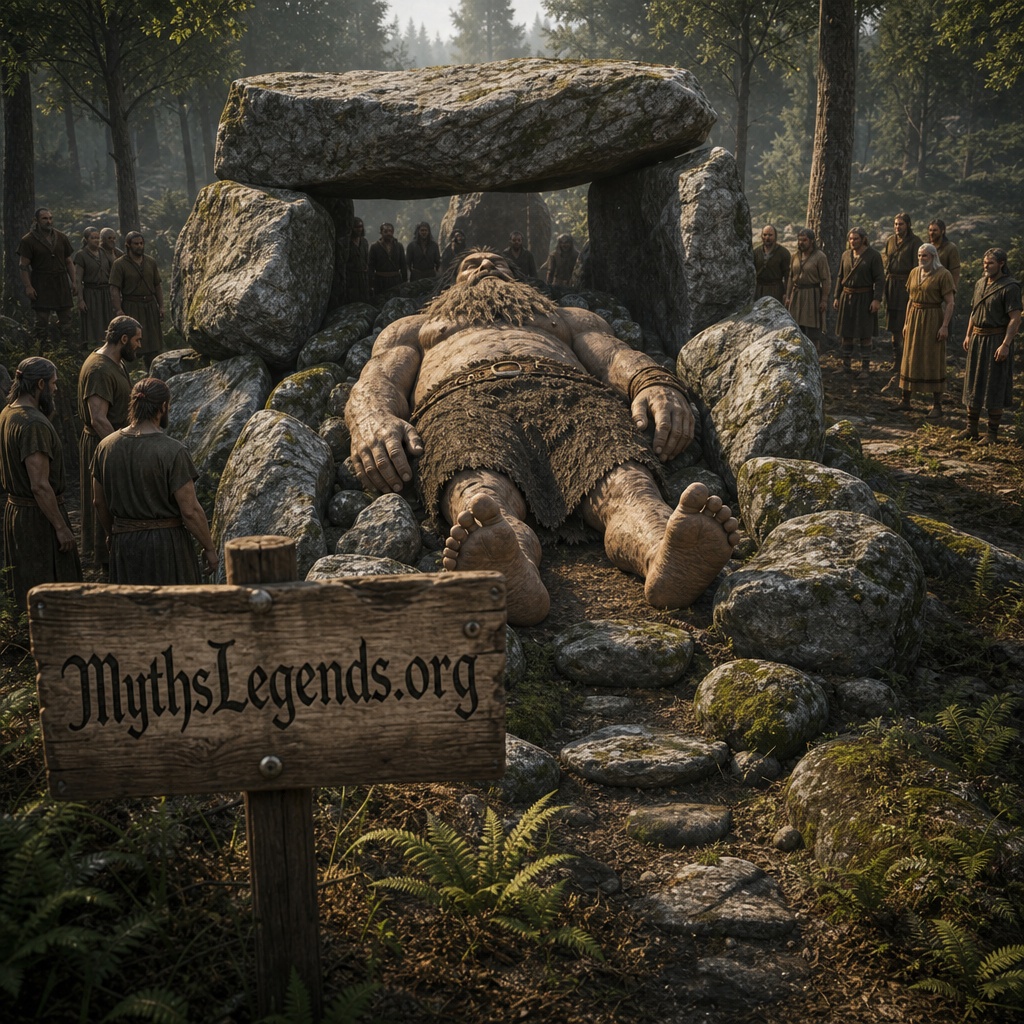
The Secret of the Giant’s Bed: A Legend from the Braunschweig Region
In the vast landscapes of northern Germany, where mist envelops the gently rolling fields and ancient forests whisper tales of times long past, there is a place steeped in myths and mysteries: the so-called Hünenbett. This mystical place is situated near Braunschweig – a city known not only for its rich history, but also for the legends that are closely interwoven with its region. Among all these tales, the legend of the Hünenbett stands out in particular and continues to capture the imagination of many people to this day. But what lies behind this mysterious tomb, and who was the giant whose name is inextricably linked to this place?
The Origin of the Legend – The legend of the Hünenbett is deeply rooted in North German folklore. The term ‘Hüne’ derives from traditional notions of gigantic beings who possessed extraordinary powers and were often depicted as the builders of colossal structures such as dolmens or stone arrangements. These giants, described in myths as prehistoric inhabitants of the landscape, are said to have left their mark on the region centuries ago. According to tradition, the Hünenbett came into being following the death of a mighty giant. It is said that this legendary giant was a good-natured and powerful being who once guarded the fields and forests around Braunschweig. When he died, the people from the surrounding area gathered to create a final resting place for him that would do justice to his stature and significance. They erected a monumental tomb from large boulders, which they are said to have arranged with impressive precision. The remains of this tomb are said to still be found in a specific spot today – some say it is a cluster of megaliths peeking out from between the trees.
The distinctive features of the dolmen – According to some accounts, the stones that make up the dolmen are said to possess magical properties. It is reported that at sunrise, the sunlight falls on the stones in a special way, causing them to radiate a mysterious aura. There is also talk of nocturnal light phenomena around the dolmen, which some interpret as a sign of the site’s supernatural powers. Such reports have contributed to the dolmen increasingly becoming a place of mystical allure over time. There are even stories that those who touch the stones have unusual dreams the following night or experience visions from times gone by. This has prompted many people – including historians, those interested in the occult and simply the curious – to visit the dolmen to experience the magic of the place for themselves.
Historical interpretation and archaeological evidence – Whilst the legend of the Hünenbett captures the imagination, it also raises the question of the extent to which historical and archaeological facts might support this story. In academic circles, the term ‘Hünenbett’ is often used as a synonym for dolmens – that is, megalithic structures erected during the Neolithic period from around 3500 to 2800 BC. These burial mounds were often built from massive stone blocks and presumably served as burial sites for the communities of that time. It is therefore possible that the Hünenbett near Braunschweig is in fact the remains of such a prehistoric structure. Historians suspect that the notion of giant ‘Hünen’ who built these stone tombs stems from the fact that people of that time could not explain how such colossal structures had been erected without modern technology. They therefore attributed the construction of the tombs to supernatural forces or gigantic beings. Archaeological investigations of the megalithic tombs in northern Germany have shown that they were often built from locally available stones that had been transported into the region from Scandinavia by glacial movements. These boulders were hauled to the site with enormous effort and arranged with precision – an astonishing feat for that time, which further fuelled the belief in the involvement of giants.
The significance of the legend for the region – The legend of the Hünenbett is not only a fascinating story, but also an integral part of the cultural heritage of the Braunschweig region. It tells not only of the region’s mysterious past, but also of the fears, hopes and imaginings of the people who have passed these stories down through the generations. To this day, the legend continues to attract visitors to the region and contributes to its appeal as a tourist destination. Walkers, history enthusiasts and nature lovers alike come here to experience the atmosphere of the area and feel the mystery of the Hünenbett at first hand. For many, a visit is more than just an outing into nature – it is a journey into the past, to a time when legends were part of everyday life and the boundary between reality and fantasy was blurred. The legend has also left its mark on art and literature. Writers and painters have drawn inspiration from the stories surrounding the Hünenbett and created works that capture the mystical beauty and emotional depth of the legend. This is an example of how local myths can take on new forms across generations and keep a region’s culture alive.
The Giant’s Grave: A Fusion of Myth and Truth – The legend of the Giant’s Grave near Braunschweig illustrates how myths and historical facts are often intertwined. Whilst the existence of gigantic giants probably belongs in the realm of fiction, the remains of megalithic burial sites serve as a reminder that our ancestors were capable of erecting impressive monuments – monuments that still bear witness today to the splendour and ingenuity of past civilisations. Although scientific studies of the megalithic tombs have answered many questions, there is still room for imagination and speculation. Are the reports of magical lights and eerie dreams mere figments of the imagination? Or is there perhaps a grain of truth in the old tales after all? Such questions help to keep the myth alive even in the present day and ensure that it is constantly reinterpreted.
A legend that brings people together – The megalithic tomb near Braunschweig is more than just a site of historical significance – it is a symbol of the connection between the past and the present, between nature and humanity, between reality and myth. The legend of the giant who is said to be buried there may sound fantastical, but it opens a window into the minds of our ancestors and invites us to reflect on the mysteries of life. In a world increasingly shaped by technology and rationality, places like the Hünenbett remind us that myths and stories not only provide entertainment, but also build a bridge to our roots. Anyone who follows in the footsteps of this legend embarks on a journey full of wonder and discovery – a journey that teaches us that a touch of magic may be hidden in every stone, in every shadow of an ancient landscape.










Post Comment