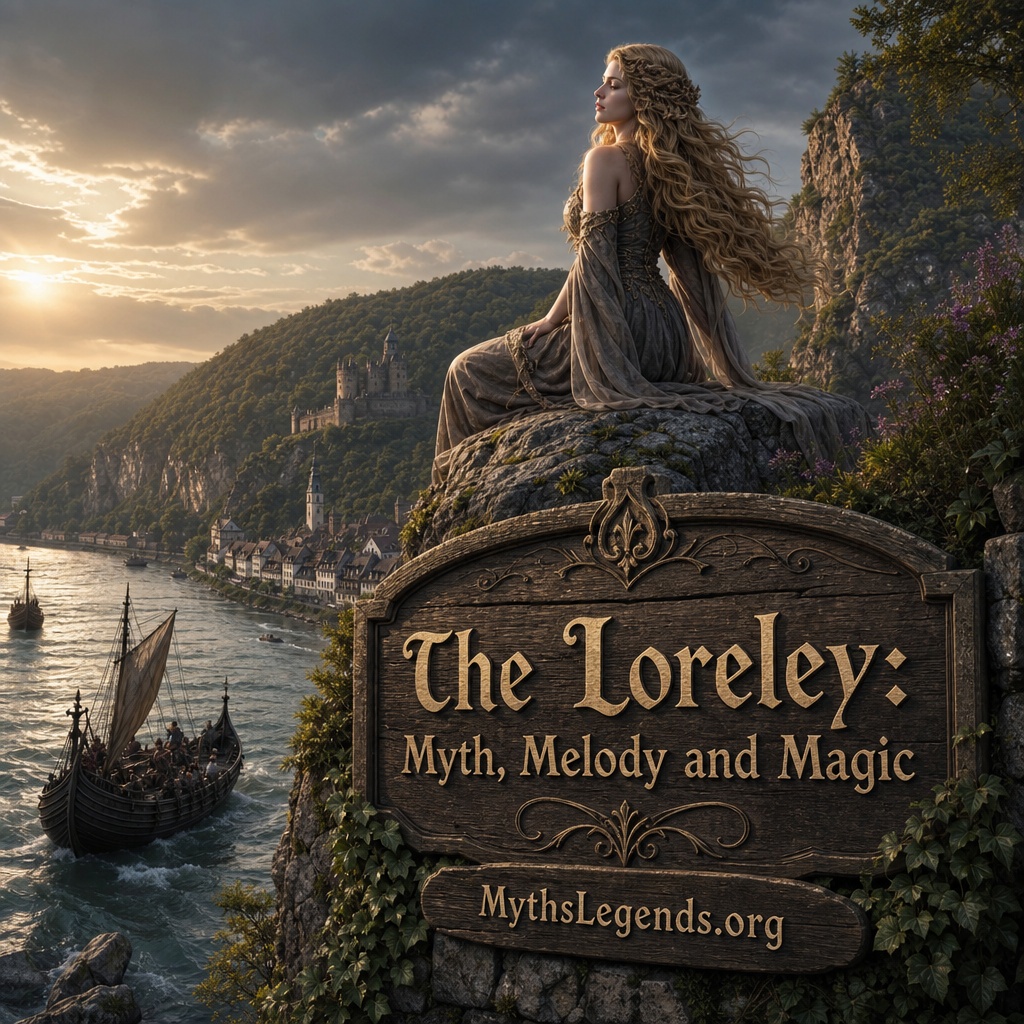
The Enchanting Legend of the Loreley: Myth, Magic, and Deadly Seduction
Anyone traveling along the Rhine who reaches Sankt Goarshausen will inevitably be drawn to a rock that rises majestically above the river landscape: the Loreley. But behind this impressive natural monument lies far more than mere geology. The Loreley is a mystical figure—a tragic symbol of German Romanticism and mythology that has captivated artists, writers, and travelers for centuries.
The Myth: A Seductive Nymph on the Rhine – The legend tells of a beautiful maiden named Loreley, who sits high up on the rock. She combs her long, golden hair with a glittering comb while singing a beguiling song whose sounds echo across the Rhine. It is said that this melodious call was so irresistible that passing boatmen could not resist it. Spellbound by her otherworldly beauty and her song, they lost sight of the river’s dangers, steered their boats into treacherous currents, and ultimately capsized in the wild waters of the Rhine. Thus, the Loreley became not only the embodiment of romantic ambivalence—of beauty and danger—but also the cause of countless disasters. Interestingly, this myth does not stem from an ancient folk tale, as one might assume. Rather, it was the poet Clemens Brentano who first brought the Loreley to life in literary form in the early 19th century. In his ballad “Zu Bacharach am Rheine” (At Bacharach on the Rhine), he tells the tragic story of a young woman who, because of her supernatural allure and the fatal effect she had on men, was mistaken for a witch. She drove numerous men to their deaths until she herself, consumed by heartbreak, met her end on the cliff. Her condemnation and her leap into the depths ultimately transformed her into the legendary figure we know today.
From Brentano to Heine: The Evolution of the Loreley Figure – While Brentano created the Loreley as a tragic and magical figure, it was Heinrich Heine who permanently enshrined her in German cultural heritage. His world-famous poem “Die Lore-Ley,” later set to music by Friedrich Silcher, paints a particularly romantic picture of this mysterious woman. Unlike Brentano’s version, the focus here is more strongly on melodic seduction—an aspect that definitively made the Loreley a symbol of deadly beauty. Heine’s poem is simple yet powerful. It describes the Loreley as a kind of siren whose song and appearance cast a spell over men. The text conveys not only the magic but also the grim consequences of an encounter with her: “I do not know what it means, / That I am so sad…” These lines express the enigmatic and melancholic aura that surrounds the Loreley. The poem became so popular that it was long considered a folk song—an ironic fact, since Heine himself was of Jewish descent and his works often sparked controversy in the nationalistic Germany of the 19th and 20th centuries.
The Loreley and Her Mythological Origins – The legend of the Loreley bears interesting parallels to ancient myths and other tales. The idea of a woman who lures men to their doom through her beauty and song is strongly reminiscent of the sirens from Greek mythology. The nymph Echo, who is turned into a rock and whose voice resounds as an echo, also seems to have been a source of inspiration. Brentano’s Loreley skillfully combines these elements of classical mythology with the mystical atmosphere of the Romantic Rhine Valley, which serves as the setting for many such stories. Some interpretations even claim that the Loreley is a reflection of nature itself—beautiful, powerful, and dangerous all at once. The echo off the rock, the roaring waterfalls, and the treacherous currents of the Rhine—which once claimed the lives of countless sailors—could be seen as metaphors for the unpredictable forces to which humans are at the mercy of.
The Origin of the Name: A Mystery Full of Meaning – The name “Loreley” itself remains a mystery to this day. Historians and linguists speculate that “Ley” originates from the Celtic language and simply means “rock” or “stone.” But the exact meaning of “Lore” remains unclear. Some theories link the term to the sound of the river—a “howl” or “cry” that echoes off the rock. Others interpret the name as “lurking rock” and attribute this to the eerie presence of the mystical woman who lurks on the rock. This linguistic origin shows just how much the rock was already, even in pre-Romantic times, a place of mystery and natural power that stirred the imagination of those who beheld it.
A Magnet for Tourists and Culture Enthusiasts – Today, the Loreley is far more than a literary motif. The 132-meter-high slate cliff is one of Germany’s most famous landmarks and attracts thousands of visitors each year. Whether nature lovers, history buffs, or romantics—everyone comes here to experience the legendary atmosphere. The lookout point is particularly popular, offering a breathtaking view of the Rhine Valley and the surrounding castles. Not far away is the Loreley Museum, which delves deeply into the region’s culture and natural treasures and keeps the history of the rock alive. In addition, events are regularly held on the nearby open-air stage, including rock concerts, theater performances, and festivals, making the Loreley a place of modern encounter.
The Loreley as an Artistic Icon and Its Timeless Appeal – The Loreley lives on not only in poems and songs, but also in paintings, sculptures, and modern media. Artists such as Philipp Foltz, Emil Krupa-Krupinski, and Carl Joseph Begas have immortalized the Loreley in Romantic paintings, always with a touch of tragedy and mysticism. Sculptors have cast their vision of her in stone and bronze, such as the impressive statues along the Rhine. Over the centuries, the figure of the Loreley has lost none of her fascination. She is a symbol of the power of nature, of the magic of Romanticism, and of the dark side of human desire. Her story reminds us how narrow the line between beauty and danger can be—and that the most tempting things are often those that can lead us to ruin.
The Loreley Remains Unforgotten – The Loreley is far more than a rugged cliff on the Rhine—she is an eternal legend that blends history and mythology. Her otherworldly beauty and melancholic song not only led sailors to their doom but also made her an immortal figure in German literature and culture. Whether you’re following in the footsteps of her legend, visiting the majestic rock, or enjoying a concert on the Loreley stage, one thing is certain: The Loreley will continue to capture people’s imaginations, and her tragedy will never fade.










































Post Comment