The Basilisk of the Mirail Fountain – The Dark Legend of Bordeaux
Bordeaux, the famous city in south-western France, is known not only for its fine wines and architectural beauty, but also for its many legends and myths. One such story, which has captured the imagination of locals and visitors alike for centuries, tells of an eerie and terrifying creature: the Basilisk of the Mirail Fountain. This mystical monster is said to have once struck terror into the city, and its story remains an integral part of local folklore to this day. But what lies behind this dark tale? Let’s delve into the historical legend and the cultural context of this fascinating myth.
The Origin of the Legend – The legend of the basilisk dates back to the Middle Ages, a time when superstition and tales of eerie creatures were rife. It is said that the monster lived in a well in the Le Mirail district, a part of Bordeaux that no longer exists, which was mainly inhabited at the time by fishermen and humble craftsmen. The well served as the local water supply, but one day eerie things began to happen: people who approached it vanished without a trace or were found dead. Soon, rumours began to circulate that a deadly creature was lurking in the well – a basilisk. In European folklore, the basilisk is regarded as a hybrid creature, often described as a combination of a snake and a rooster, and sometimes even exhibiting dragon-like features. Its gaze is said to be deadly, and it spread fear and terror wherever it appeared. For the inhabitants of Bordeaux, the Mirail Well became a symbol of a danger that nobody understood, but which was ever-present.
The impact on the population – The legend recounts how the fear of the basilisk had a massive impact on the lives of the inhabitants. The Mirail Fountain, once the centre of daily life, was suddenly shunned. People began to fetch water from distant sources, even though this involved considerable effort. Traders who had previously sold their wares near the fountain sought out other locations, and the once-vibrant neighbourhood was transformed into a less-frequented area. The religious leaders of the time also felt compelled to act. In a world shaped by faith and superstition, the population desperately sought protection and salvation. Priests and monks were summoned to bless the well and purify it of its ‘demonic presence’. Sometimes it was precisely these rituals themselves that further fuelled the legend, as their effectiveness apparently failed to fully reassure the people. The fear of the basilisk persisted and shaped social life in Bordeaux for many years to come.
The alleged origin of the monster – Where the creature came from and why it was said to be wreaking havoc at the fountain remains a mystery to this day. Some interpretations suggest that the basilisk was created by a curse – perhaps by an angry spirit or a forsaken soul seeking revenge on the city. Others speculate that it was an animal whose behaviour was misunderstood by people and which subsequently became a symbol of terror. There are also indications that the legend may be linked to trade routes and seafaring. At that time, Bordeaux was a major port city where goods from all over the world arrived. Perhaps a merchant brought a venomous creature back from distant lands which, after it had escaped, came to be known as the basilisk. In an age when there were as yet no scientific explanations for many natural phenomena, the human mind often sought refuge in fantastical, yet terrifying, tales.
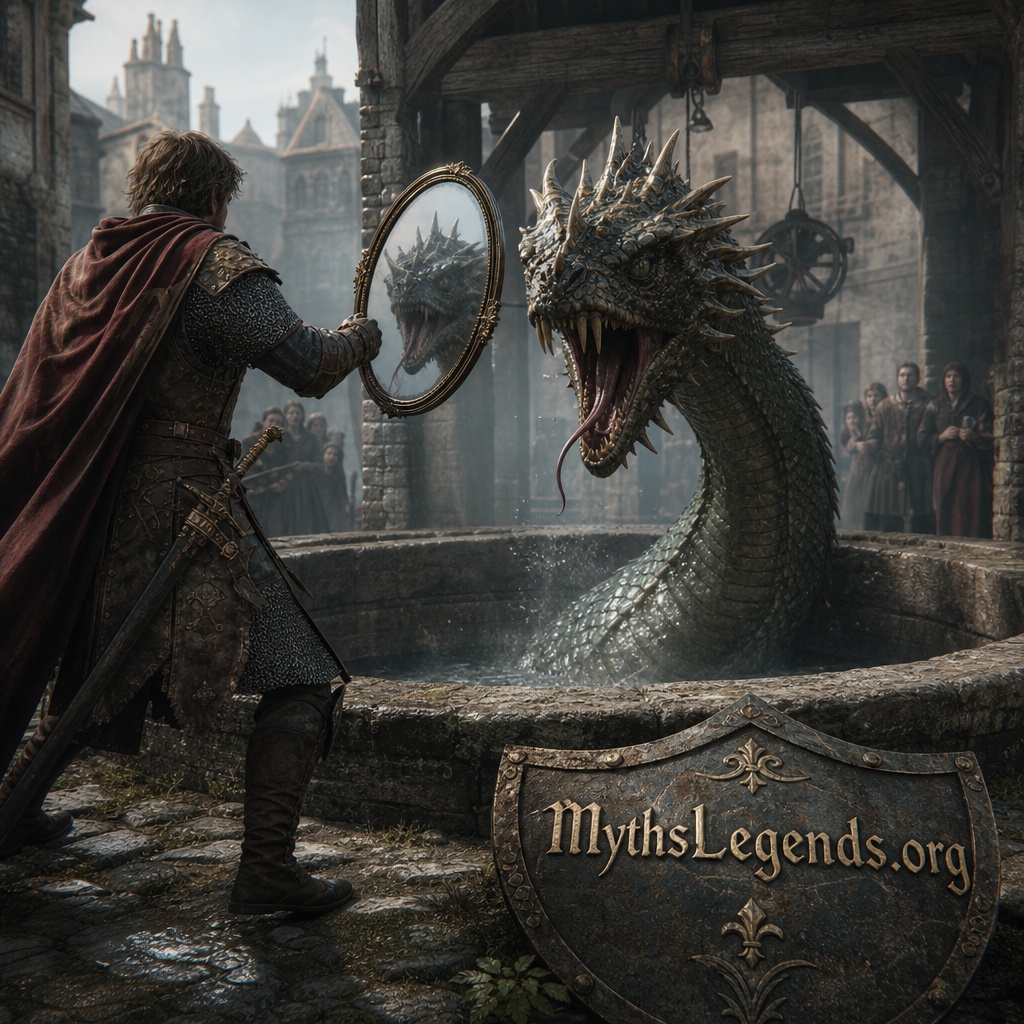
The Battle Against the Basilisk – A particularly gripping episode of the legend tells of a hero who is said to have defeated the basilisk. The name of this brave figure varies depending on the source; sometimes he is described as a simple soldier, sometimes as a knight. The story goes that this man armed himself with a mirror to confront the basilisk. As the monster’s gaze was deadly, the hero resorted to a ruse: he held the mirror before him so that the basilisk saw its own reflection. It is said that this reflection caused the creature to destroy itself. The exact circumstances of this battle, however, remain as vague as the existence of the basilisk itself. This episode vividly illustrates how deeply the medieval imagination was shaped by symbolism and religious imagery. Here, the mirror stands for wisdom and mental strength, which ultimately triumphed and freed the city from its terror. Whether the fountain was subsequently put back into use or continued to be shunned, the legend remains silent on this point.
Historical Context and Significance of the Legend – The story of the basilisk has been part of Bordeaux’s history for centuries, but above all it reflects the fears and hopes of a bygone era. In the Middle Ages, access to education and scientific knowledge was limited, and many phenomena that can be explained rationally today were regarded at the time as the work of divine or demonic forces. Unexplained deaths or strange illnesses were often attributed to supernatural causes, and this is likely the origin of many such legends, including that of the basilisk. Furthermore, such a story serves as a mirror of social and cultural dynamics. It shows how heavily communities relied on myths and stories to bring order and structure to a chaotic world. In this sense, the basilisk stands not only for fear, but also for humanity’s ability to face an unknown danger – be it through courage, cunning or faith in higher powers.
Modern Reception – Today, the legend of the basilisk of the Mirail Fountain is more of a cultural relic, occasionally revived in historical narratives and city tours. The Mirail Fountain itself has long since ceased to exist; the neighbourhood was transformed by the city’s modernisation and can now only be found in old documents. Nevertheless, the story continues to fascinate locals and tourists alike. It offers an insight into the medieval imagination and invites us to view the city of Bordeaux from a different perspective. In modern interpretations, the legend is often understood as a metaphor – whether for the struggle against inner demons or for overcoming fear through wisdom and courage. Writers, artists and historians repeatedly revisit the story to highlight new perspectives and reflect on it within the context of our modern world.
The basilisk of the Mirail Fountain is more than just a spooky legend from the past. It stands as a testament to the power of myths and their role in shaping cultural identity. Bordeaux, a city steeped in history and symbolism, has preserved this myth in its narratives and made it an integral part of its rich folklore. Although the fountain has long since disappeared and the basilisk probably never really existed, its story lives on – in books, songs and in the minds of those fascinated by the mysterious shadows of the past.














Post Comment