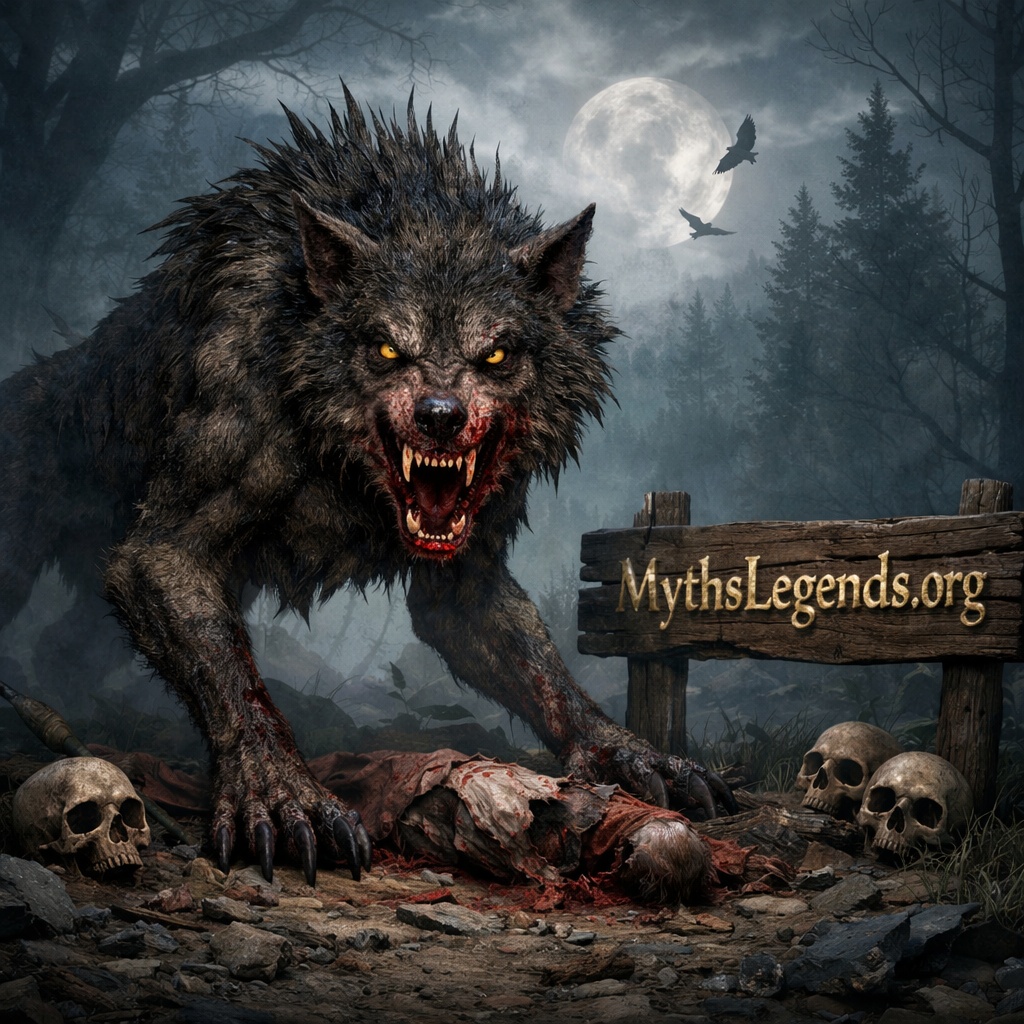
The Beast of Gévaudan: A Mystery Between Legend and Reality
Between 1764 and 1767, the mountainous region of Gévaudan in southern France became the scene of a series of brutal attacks that plunged the region into fear and terror. According to reports, an unknown creature is said to have killed more than 100 people and injured countless others. Despite an intensive hunt and countless speculations, the true nature of this so-called “Beast of Gévaudan” remains unexplained to this day, making it one of Europe’s most fascinating and, at the same time, most eerie legends.
An Unexplained Phenomenon – The first reports of attacks by a strange animal date back to the summer of 1764. Near the village of Langogne, a young woman fell victim to a creature described as a cross between a wolf and a big cat. She spoke of a “huge animal with an elongated head, broad chest, and powerful teeth.” Unlike ordinary wolves, it seemed to have no fear of humans and attacked deliberately. Soon, reports of similar incidents began to pile up, and fear spread throughout the region. What made the events particularly terrifying was the brutality of the attacks. According to reports, the animal often ripped its victims’ throats open, causing them to die at the scene of the attack. Many bodies showed signs of mutilation, suggesting an exceptionally aggressive and powerful predator. The rural population was overwhelmed by the attacks and felt compelled to take increasingly drastic protective measures, such as organizing group patrols and night watches or traveling on country roads with armed escorts. Yet despite these precautions, the killing spree continued for months.
The Search for the Truth: Manhunts and Speculation – The French government soon became aware of the incidents, as the scale of the attacks had both economic and social consequences. King Louis XV dispatched professional hunters to contain the threat. Among them was Jean-Baptiste Duhamel, a dragoon captain who roamed the forests for several weeks with over 30 armed men, but to no avail. Even after the king himself offered a substantial reward for the capture of the beast, it remained untraceable at first. The length of the hunt and the multitude of reports led to the wildest speculations. Among the most common theories was the assumption that it might be an exceptionally large wolf or a mutated variant. Some believed in the possibility of a cross between a dog and a wolf, which would explain the unusual characteristics: the large size, the elongated build, and the aggressive behavior. Others, however, assumed that the animal was of exotic origin, such as an escaped lion or tiger that had been brought to Europe by a nobleman or merchant. Another theory that sparked controversy was the idea that the beast might not be an animal at all, but a human—a serial killer who staged the attacks to cover up his atrocities. However, this theory was never proven and remains speculative. Interestingly, some survivors reported that the beast was often seen accompanied by a second, smaller animal, which could suggest that it was actually part of a pack.
The Turning Point: The Death of the Beast – The turning point came in 1765, when François Antoine, the king’s master of arms, killed a large wolf after an intense hunt; the wolf reportedly exhibited many of the characteristics described for the Beast. The carcass was taxidermied and presented at court. The public took hope that the attacks had come to an end. But this confidence was short-lived: even months after the wolf’s death, new attacks occurred that were clearly attributed to the Beast once again. The myth lived on. It was not until June 1767 that the farmer Jean Chastel is said to have finally put an end to the Beast. He killed another animal that experts described as a cross between a wolf and a dog. Although this animal bore many similarities to earlier reports, it could not be said with certainty whether it was indeed the perpetrator of all the attacks. Nevertheless, the attacks ceased abruptly, and the legend of the Beast of Gévaudan came to an end. The carcass was later stuffed and preserved for many years before it was lost.
Fact or Fiction? The Aftermath of the Legend – To this day, the identity of the beast remains an unsolved mystery. Historians and scientists have attempted to analyze the reports and find possible explanations. One hypothesis suggests that the attacks were not carried out by a single animal, but by several wolves that had become unusually aggressive due to hunger or illness. This theory is supported by the fact that the Gévaudan region was suffering severely from poverty and food shortages at the time, which may also have affected the animals’ natural hunting grounds. Another common explanation is psychological in nature: the enormous fear and uncertainty among the population may have led to exaggerations in the reports. Individual, ordinary wolf attacks may thus have been linked together and stylized into a “super-beast.” The fact that the attacks were often accompanied by dramatic descriptions leaves room for the assumption that reality and fantasy became intertwined. The Beast of Gévaudan has not only shaped the history and folklore of France but has also found its way into popular culture. It has been the subject of novels, films, and documentaries and continues to represent the eerie intersection between myth and science. Even if the truth behind the legend may never be fully clarified, the story remains a reminder of humanity’s deep-rooted fear of the unknown—and of the limits of knowledge in an era when nature and humanity were often locked in bitter competition.
The Enduring Fascination – The Beast of Gévaudan is an example of how local events can become global myths. Its story not only reflects the fears and challenges of that era but also demonstrates how powerfully the human imagination and storytelling can contribute to the creation of legends. Whether it was a mutated wolf, an exotic animal, or simply a chain of misunderstandings—the “Beast of Gévaudan” remains a symbol of the inexplicable and the untamed power of nature.






Post Comment