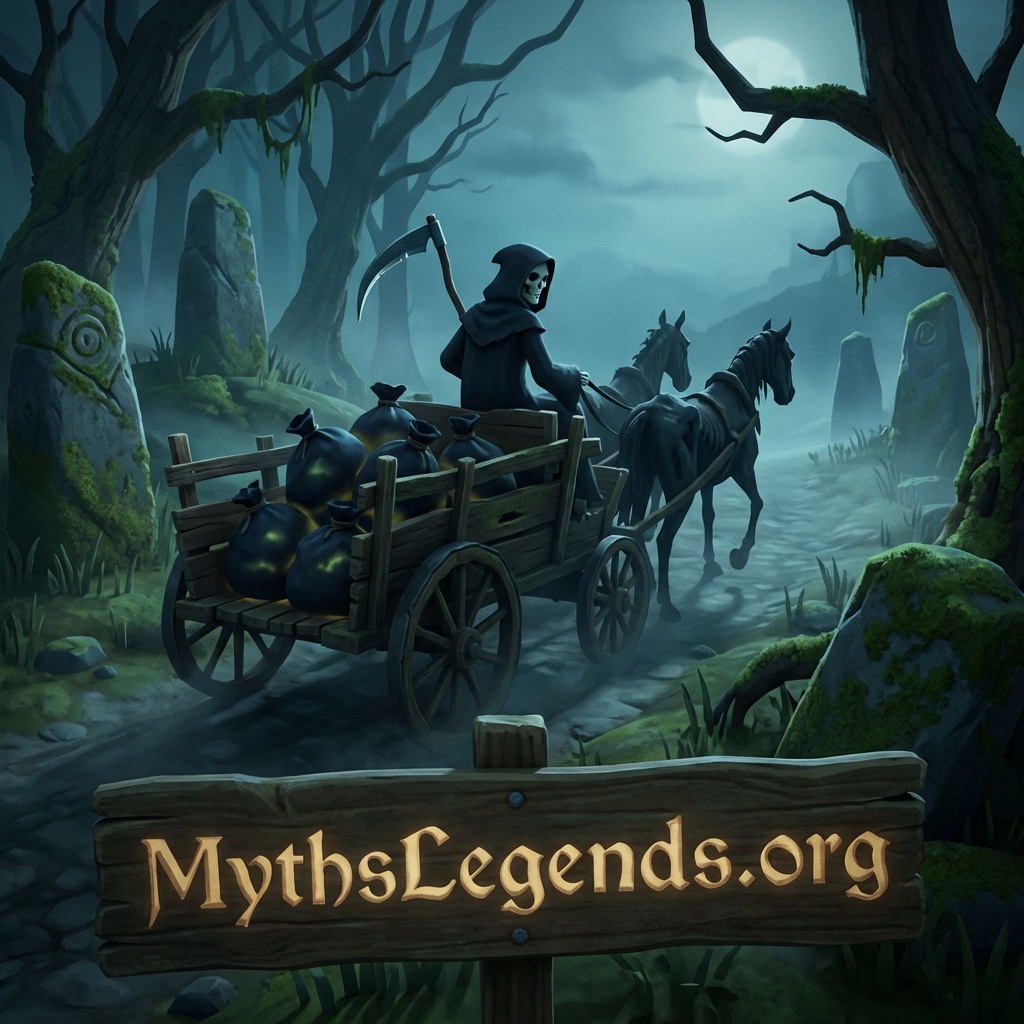
Ankou – The Messenger of Death in Brittany and His Rattling Cart
Breton mythology is home to many fascinating figures, but none is as eerie and haunting as the Ankou. He is considered the personification of death and wanders restlessly through the land, using his rattling cart to capture the souls of the deceased. The Ankou is far more than just a mythical figure—he embodies the inescapable certainty of death, a universal truth that has been deeply rooted in the cultural consciousness of Brittany for centuries. But who is the Ankou really, and what stories surround this grim servant of the afterlife?
The Ankou – Guardian of the Boundary Between Life and Death – In the legends, the Ankou always appears on a wooden cart, supported by gnarled old wheels and pulled by ghostly horses. The clattering of the cart, often interpreted as an omen of approaching death, is his trademark—and at the same time a warning to the living to be on their guard. In some stories, the Ankou steers this cart himself; in others, he is accompanied by silent figures who assist him in his work. The Ankou is often described as a tall, gaunt figure wearing a long cloak and a hood that conceals his face. His tool is a scythe or sometimes an axe, which he carries with him, ready to “reap” the souls of the recently deceased . It is said that the Ankou makes no distinctions—whether young or old, poor or rich, no one is spared his visit.
Origins and Symbolism of the Ankou – The origins of the Ankou lie deeply hidden in Breton folklore, although some historians and mythologists draw parallels to Celtic and Christian culture. In Celtic traditions, there are numerous figures associated with death and the transition to the afterlife. Some speculate that the Ankou is an evolution of older Celtic death gods or spirits, while others view him as a fusion of pagan and Christian beliefs. In Breton mythology, the Ankou fulfills a role that goes beyond that of a mere figure of terror. He is a guardian of the threshold between life and death, a mediator between the worlds. He reminds the living not only of their own mortality, but also that death is a natural part of existence—a transition from which no one escapes.
Regional Variations and Stories – The legends surrounding the Ankou vary depending on the region within Brittany. In some stories, he is portrayed as the soul of the village’s most recent deceased; this person is chosen to take on the duties of the Ankou for a year before finally finding peace. Other traditions recount encounters with the Ankou, which are often interpreted as warnings of impending misfortune or death. A particularly well-known legend tells of a blacksmith who was working late one evening when he received an unexpected visit from the Ankou. The harbinger of death asked the blacksmith to repair the wheel of his cart. Although the man hesitated at first, he eventually decided to help the eerie figure. In gratitude, the Ankou promised to spare him and his family from an early death. This story shows that the Ankou is not only seen as a merciless collector of souls, but also as a kind of just judge who rewards those who show him respect and obedience.
The Connection to Everyday Life in Brittany – Belief in the Ankou was once ubiquitous in many Breton villages. People believed that the creaking of wagon wheels on lonely country roads was a sure sign that the Ankou was on his way. The dead were often treated with the utmost respect, in the hope of appeasing the Ankou and not provoking his wrath. Even today, the Ankou holds a firm place in Breton culture. Although most people today view him as a mythological figure, in many ways he reflects Brittany’s deep-rooted relationship with death and transience. Many works of art, books, and folk songs are dedicated to this grim harbinger of death, keeping the stories alive.
Myth or Reality? – As with many figures in folklore, the question arises: Is the Ankou a real spirit, a product of the collective imagination, or simply a symbolic representation of death? For the people of Brittany, the Ankou was and remains more than just a creepy fairy-tale figure; he embodies a time-honored philosophy that accepts death as an inevitable part of life. His stories remind us that life would lack the same depth and meaning without the certainty of death.
An Eternal Echo of Death – The Ankou remains a fascinating figure in Breton mythology—an eerie yet deeply symbolic character who guards the boundaries between life and death. With his clattering cart and somber aura, he serves as a reminder of mortality and the inevitability that affects every human being. His stories may send shivers down our spines, yet they also offer comfort: for as terrifying as this harbinger of death may seem, he follows strict rules that preserve the balance between the worlds. The Ankou reminds us that time is precious—and that every moment counts.














Post Comment