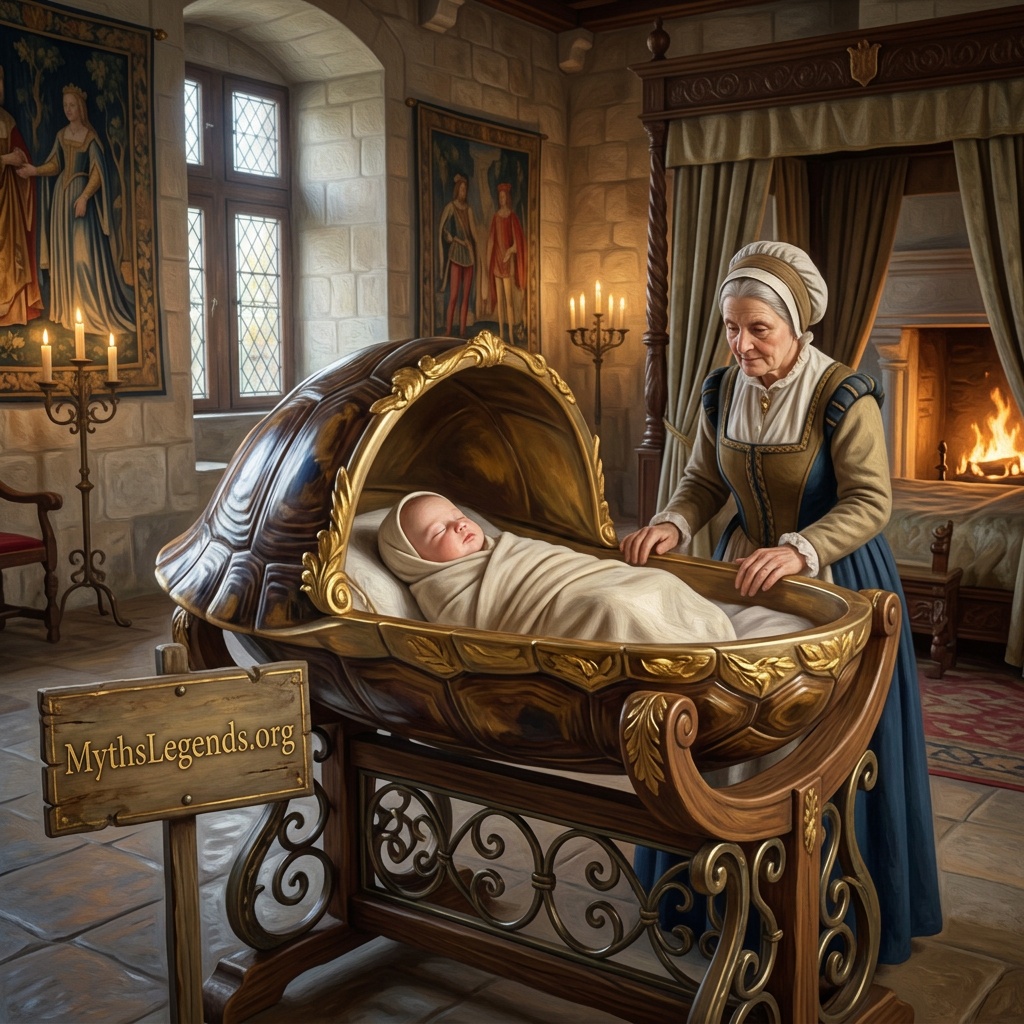
The Turtle Cradle and the King Who Brought Peace – The Birth of a Legend
Henry IV, who would later go down in history as one of France’s most famous kings, was born on December 13, 1553. His birthplace, the Château de Pau, a picturesque castle in the Pyrenees, thus became the setting for a legend that continues to fascinate generations to this day. Above all, however, a legend surrounding his birth has become deeply ingrained in the cultural memory and accompanies the life of “Good King Henry” like a magical shadow: the story of the turtle cradle.
The Birth of an Extraordinary Child – The legend tells that Henry was surrounded by extraordinary signs even at his birth. His mother, Jeanne d’Albret, a devout Protestant and Queen of Navarre, is said to have vowed to her unborn child that she would raise him as a defender of the faith, while his father, Antoine de Bourbon, a Catholic prince, hoped for a political future for his son. Even at this early stage, the conflicts that would shape Henry’s life were evident: the religious tensions between Catholics and Protestants that were shaking Europe. But it was not only the political and religious significance of his house that made Henry’s birth a special event. Legend tells of an unusual ritual that his mother ordered to shape her son’s strength and character. Shortly after his birth, Jeanne d’Albret is said to have rubbed him with garlic and dripped a little wine onto his lips—both symbols of strength and bravery. In this way, she wanted to ensure that her son would be both physically strong and endowed with an unshakable spirit. This symbolic act underscores the significance of this newborn in the eyes of his family and society, with the legend already portraying him as a hero even before he took his first breath.
The Mysterious Tortoiseshell Cradle – To this day, the Château de Pau preserves a special relic that made Henry’s birth a legendary event: a tortoiseshell cradle. According to legend, Henry was not laid to rest in an ordinary crib, but in this extraordinary object, which served as a kind of protection and, at the same time, as a symbol of the child’s uniqueness. Why a turtle, of all things? In many cultures, the turtle is considered a symbol of longevity, steadfastness, and wisdom—qualities that were likely also wished upon the newborn prince. Some historians speculate that this choice was a deliberate move by his mother to portray Henry, even as an infant, as a future strong leader. Others interpret the turtle cradle as a kind of good-luck charm intended to protect him from the turbulent political times that lay ahead in his life. The cradle itself has been preserved for centuries and can still be viewed today at the Château de Pau. It has become a symbol of Henry IV’s life and attracts thousands of visitors each year who wish to learn more about the legends and stories surrounding this extraordinary king.
A Destiny That Shaped Legends – It became clear early on that Henry’s life would be anything but ordinary. The religious conflicts that dominated Europe at the time of his birth would later have a profound influence on him as an adult and ultimately secure his place in history. But before Henry was crowned king, his path led him through many challenges and trials that shaped him into the “Good King Henry” whom the people revered. The legends surrounding his birth serve not only to glorify his life but also to emphasize his role as a peacemaker and leader. His mother, Jeanne d’Albret, is often seen as the driving force behind these legends. Her strict upbringing and her focus on her son’s moral strength fostered the myth surrounding his extraordinary birth and made him an almost mythical hero in the eyes of his followers.
Good King Henry”: A Life Between Reality and Legend – Over the course of his life, Henry IV evolved into a man who could offer stability and hope to a torn nation. France was marked by religious civil wars during his time, and his pragmatic approach to the country’s problems earned him respect and admiration. The famous phrase “Paris is worth a Mass,” which he allegedly uttered when he converted from Protestantism to Catholicism to become King of France, demonstrates his ability to set aside personal convictions for the good of his people. Against the backdrop of these later developments, the legend surrounding his birth takes on a deeper meaning. The turtle cradle, the symbolic garlic, and the drop of wine represent his strength, endurance, and wisdom—qualities that accompanied him throughout his eventful life and ultimately made him one of the most beloved monarchs in French history.
The Power of Legend-Making – What makes the legend of Henry IV so fascinating? It is not only the fact that historical facts and mystical elements are interwoven, but also the way these stories were used to shape an image of the king. Henry IV is a perfect example of how legends and myths can help shape the image of a historical figure. They are a means of glorifying a figure and anchoring them in the hearts and minds of the people. The turtle cradle may have been a simple object, but its symbolic significance grew over the centuries. It became a tangible piece of history that represented Henry’s extraordinary life. The Château de Pau thus became not only the birthplace of a king, but also the birthplace of a legend that will live on for a long time to come.
The Birth of a Legend Lives On – Henry IV has become immortal not only through his political achievements and his commitment to religious tolerance, but also through the stories surrounding his life. The turtle cradle and the legends surrounding his birth made him a mythological figure even as a newborn, long before he had even ascended the throne. The legend of Henry IV shows just how powerful stories and symbols can be. They not only help keep the memory of historical figures alive but also convey their ideals and values. Henry’s birth marked the beginning of an extraordinary journey—a journey that made him “Good King Henry” and continues to inspire people to this day. Perhaps it is precisely this blend of history and myth that ensures Henry IV lives on not only as King of France but also as a legend in the minds and hearts of people.
























Post Comment