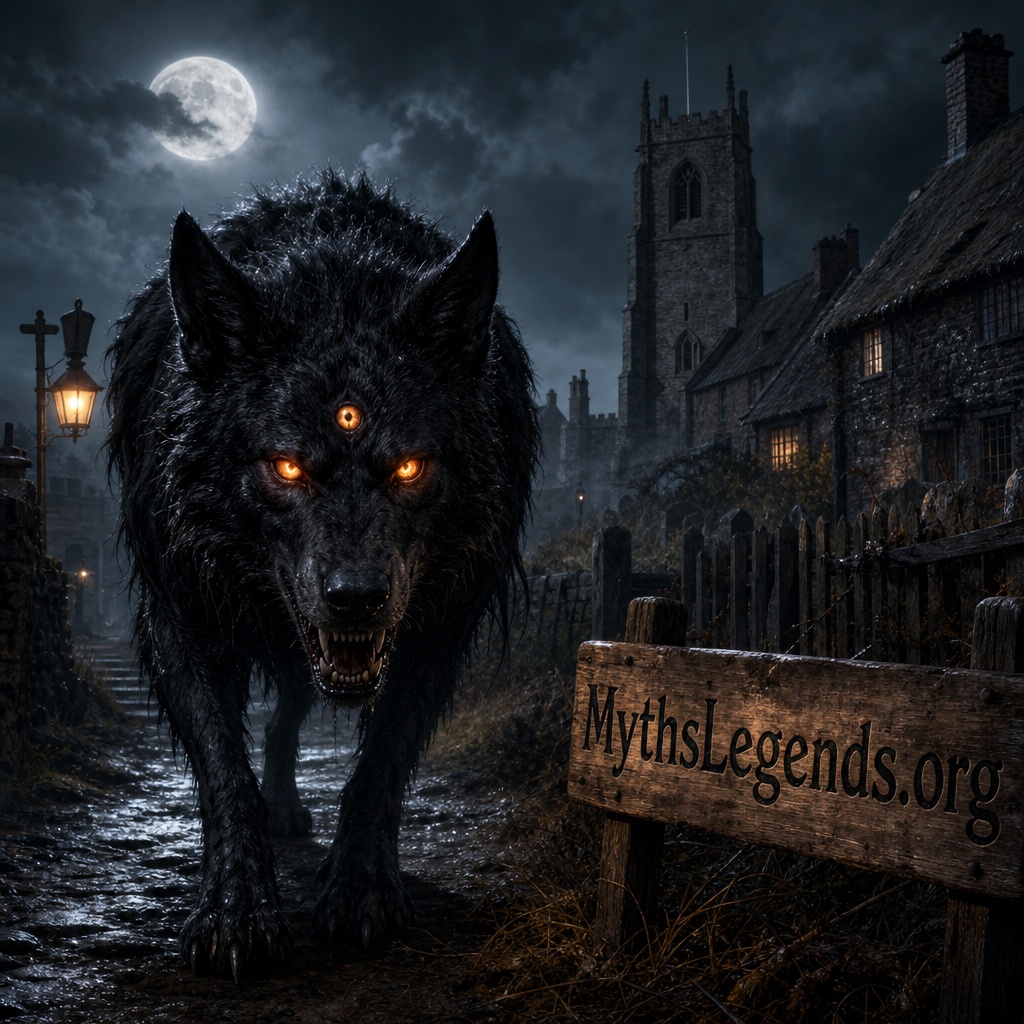
The Black Dog of East Anglia: The Legend of Black Shuck
The county of Norfolk and the region of East Anglia in the east of England are renowned for their picturesque landscapes, historic villages and mysterious coastal areas. Yet behind this idyllic backdrop lies a dark legend that has captured the imagination of the region’s inhabitants for centuries: the story of Black Shuck, a mysterious, ghostly hellhound. The giant black dog with glowing eyes is said to roam this area, spreading fear and terror.
Origin and Spread of the Legend – The roots of the legend date back to the Middle Ages. The name ‘Black Shuck’ is thought to derive from the Old English word ‘scucca’, meaning ‘demon’ or ‘evil spirit’. This creature is described as large and terrifying, with black fur that seems to shimmer in the moonlight and eyes that glow like fire. Some accounts claim that the Black Shuck has only a single eye in the centre of its forehead, which makes its appearance even more eerie. The legend spread rapidly throughout Norfolk and other parts of East Anglia, where it was passed down from generation to generation. A central element of these stories is the association of the hellhound with death and misfortune. It is said that its appearance is often a harbinger of tragedy – such as a fatal accident or the impending loss of a loved one.
Famous Encounters and Historical Influences – A particularly famous incident involving the Black Shuck took place in 1577 in Bungay and Blythburgh, two small villages in Suffolk, a neighbouring region of Norfolk. During a violent storm, the dog is said to have burst into Blythburgh Church, causing chaos and panic with its growling howls. According to reports, it attacked two parishioners and left deep scratch marks on the church door, which are still visible today. In Bungay, too, the Black Shuck is said to have appeared in a church during the same storm and caused similar chaos there. These events were recorded in contemporary writings and helped to spread the legend beyond the region’s borders. A central aspect of these stories is the connection between the Black Shuck and churches, as well as religious symbols. In early versions of the legend, the Black Shuck was often portrayed as an instrument used to punish people for their sins. This could suggest that the legend served, in part, as a moral lesson or a warning against straying from the right path – a motif found in many European myths and tales about supernatural beings.
The Black Shuck in regional folklore – Over the centuries, the legend of the Black Shuck has become deeply rooted in the folklore of Norfolk and East Anglia. Many stories surrounding the hellhound bear witness to people’s deep connection with nature. The dog is sighted particularly frequently in coastal areas and remote moorlands – places known in the region for their desolate and mystical atmosphere. In some versions of the legend, the Black Shuck is portrayed as a protector. There are reports from walkers who claim the dog guided them safely through dangerous moors and woods. This interpretation contrasts with the widespread notion of the hellhound as a harbinger of death. However, it demonstrates how flexible and multi-layered such myths can be, as they are often shaped by individual experiences and perspectives.
Possible origins and scientific explanations – As with many legends, historians and scientists are attempting to explain the origins of the Black Shuck. Some theories suggest that the stories were inspired by actual sightings of large, wild dogs that were once native to the region. Such animals may have seemed threatening to people at the time, particularly when hunting in packs or appearing at night. Another explanation could lie in the significance of the symbolism. In European folklore, black dogs are often associated with the supernatural, death or the underworld. This is also reflected in other cultures, for example in the German legend of the ‘Black Dog’ or in Irish mythology with the creature ‘Cú Síth’. Furthermore, natural phenomena may have played a role. Flickering lights, which sometimes appear in moorland areas – such as will-o’-the-wisps – may have been mistaken for the dog’s glowing eyes. The rugged coastal landscape and frequent storms in East Anglia may also have helped to shape the stories about the Black Shuck.
Influence on modern culture – Although the legend of the Black Shuck has its origins in the Middle Ages, it has lost none of its fascination to this day and remains an integral part of the cultural identity of Norfolk and East Anglia. It features in local publications, is highlighted at tourism events and has even found its way into popular culture, for example in songs, books and films. Tourists regularly visit sites associated with the Black Shuck, such as Blythburgh Church with its distinctive scratch marks on the door. Guided tours of the region often include stories about the hellhound, and local museums display artefacts said to be linked to the legend. Furthermore, the legend has found a place in modern literature and the horror genre. The Black Shuck often serves as inspiration for authors and artists, who draw on the story’s dark and mysterious atmosphere to create new works.
Preserving a piece of regional identity – The legend of the Black Shuck is more than just a spooky tale; it is an important part of the cultural heritage of Norfolk and the whole of East Anglia. Not only does it offer thrilling entertainment, but it also sheds light on the fears, hopes and imaginations of the region’s people, who have preserved the story across generations. By keeping the legend alive through both traditional folklore and modern interpretations, it helps to preserve a piece of local identity for future generations. For many, the Black Shuck remains a symbol of the connection between humankind and nature, a reminder of the mysteries that lurk in the shadows of history. And who knows – perhaps he is still waiting somewhere in the gloomy, mist-shrouded moors of Norfolk and East Anglia, ready for his next encounter with a brave wanderer.





















Post Comment