The Eerie Tale of the Possessed Agnes of Stettin – A Struggle Between Faith and Dark Forces
The story of Agnes of Stettin, who took her own life in 1577 at the so-called ‘Grey Monastery’, is one of the darkest and most fascinating tales in regional folklore. It describes the life of a young maid who suffered the torments of supposed possession for over two decades. This tale sheds light not only on the contemporary beliefs regarding demons and witchcraft, but also on the culture and the way such phenomena were dealt with in the early modern period.
A curse and its devastating consequences – It all began with a fateful event at a remote farmstead near Szczecin. The mother of little Agnete, as she was known at the time, worked there as a maid. One day she received a visit from an old woman who wanted to buy butter. But when the maid could not or would not sell her any butter, the visitor reacted with angry threats and cursed the little girl, who was innocently playing outside at the time. According to tradition, the old woman uttered an ominous curse and, so the story goes, sent the devil into her body. This fateful encounter proved to be the beginning of a nightmare that lasted for years for the family. Soon, strange and terrifying symptoms began to appear in little Agnete, which deeply shocked her parents and left them at a loss. In their desperation, they turned to the authorities in Stettin, who subsequently ensured that the alleged witch was brought to trial. Whether the old woman was actually responsible for the child’s suffering, or whether the accusations were based on a mixture of fear and a lack of understanding of medical and psychological phenomena, remains unclear to this day.
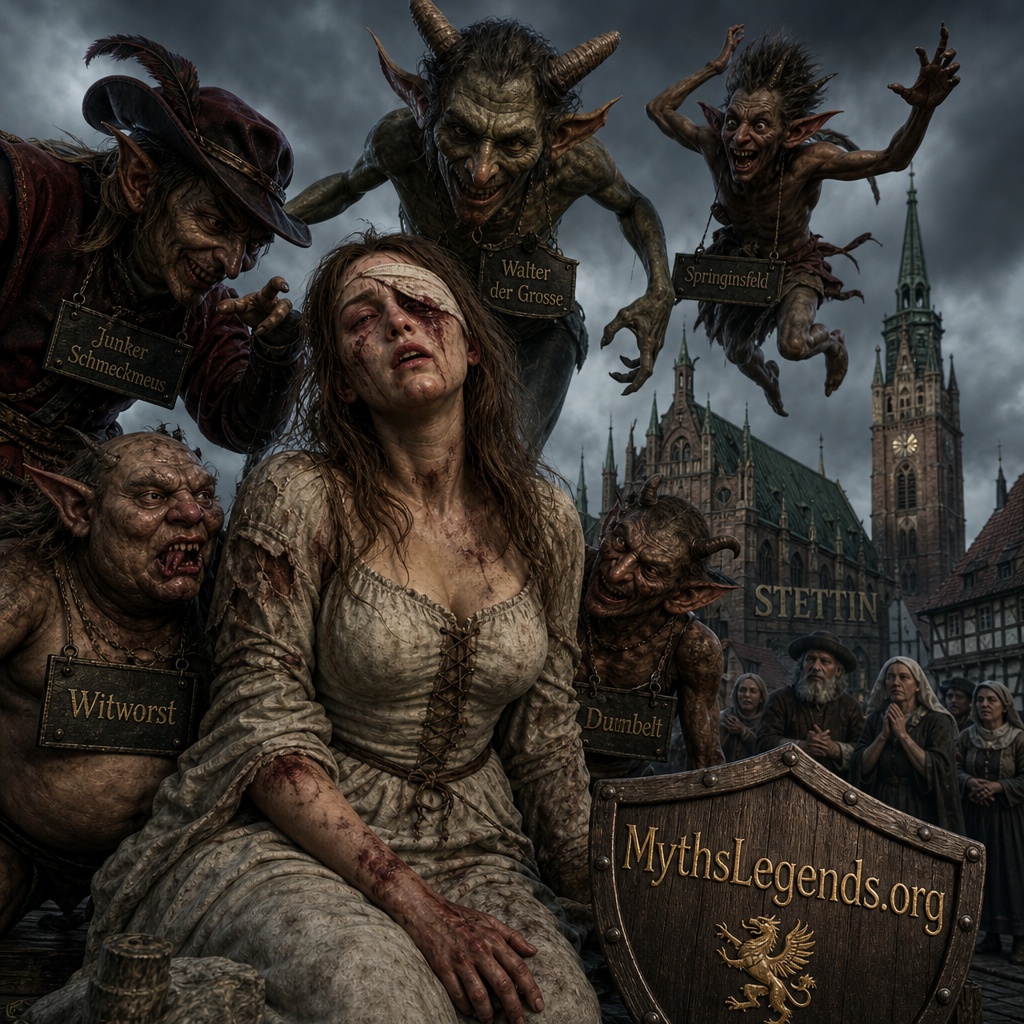
The Torments of Young Agnete – What followed were years of suffering for Agnete, who had by then grown into a young woman. Her alleged possession by five devils – whom she herself named: Junker Schmeckmeus, Walter the Great, Springinsfeld, Witworst and Dumbelt – led to a multitude of mysterious and often gruesome incidents. These evil spirits are said to have tormented her both physically and mentally. The terrifying symptoms included violent convulsions, swollen limbs and injuries, including flesh wounds and even the loss of an eye. Most unnerving, however, was the notion that the devil allegedly moved her physically – he is said to have lifted her high into the air, placed her on church roofs and even thrown her into the water. Those around her described Agnes as someone who, outside of these fits, led a pious and God-fearing life. The young woman regularly attended church, listened to sermons and received devotions and the sacraments. It is remarkable that, despite the alleged presence of demons in her body, Agnes was reportedly never attacked by them whilst in church. For the people of that time, this was proof that divine protection is stronger than satanic forces.
A mysterious ability: foreign languages and visions of the future – In addition to her physical torments, Agnes also displayed traits that both fascinated and unsettled many of her contemporaries. It was reported that she spoke foreign languages she had never learnt and that she was able to make predictions about future events. A particularly striking example was the arrival of another possessed man from Pasewalk. Agnes announced his visit and seemed to be filled with a strange joy; upon his arrival in the town, she even ran towards him, dancing. Such episodes reinforced the impression that her possession had not only a physical but also a spiritual dimension. The story also recounts other bizarre incidents, including the damage to beer barrels, which was allegedly caused by diabolical intervention. The devil, Agnes claimed, had bathed her in beer barrels, thereby spoiling the drink. These accounts provide an insight into the superstitions and everyday fears of the population at that time.
The battle against the dark forces – Throughout her youth and into adulthood, Agnes lived with the torments of her supposed possession. Yet three years before her death, these sufferings seem to have suddenly ceased. The reasons why the demons lost their power over her are not clearly stated in the account, though it is emphasised that Agnes spent her final years in peace. She eventually died in the ‘grey convent’ in Szczecin and received a Christian burial. One detail that stands out throughout the narrative is Agnes’ devotion to the Christian faith. Despite all the pain and humiliation, she held fast to her faith and found solace in the Church. This aspect suggests that the story can be understood not only as an account of an alleged supernatural event, but also as an allegory for the perseverance and power of faith in times of greatest need.
Historical Context and Interpretative Approaches – The story of Agnes of Stettin is set at a time when belief in supernatural forces was widespread. Witch trials and exorcisms were part of everyday life in many places, and understanding of illness and psychology was heavily influenced by religious beliefs. Today, one might view Agnes’s experiences from a different perspective. Many of her symptoms could point to physical or mental illnesses that were not recognised or treated at the time. Epilepsy, schizophrenia or other neurological disorders could be possible explanations. Social and cultural circumstances also played a role: women who stood out in the eyes of society were often quickly suspected of being in league with dark forces. At the same time, the question remains as to how historically accurate the account itself is. Many elements of the story may have been embellished or misinterpreted, whether through oral tradition or deliberate dramatisation by chroniclers.
Myth or Reality? – The story of the possessed Agnes of Stettin remains a fascinating example of the fears and beliefs of people in the early modern period. Whilst some aspects of her story may be based on real events, much of it is likely the result of exaggeration and superstition. Nevertheless, this tradition impressively illustrates the close links between medical, religious and social beliefs of that time. For modern readers, the story offers an opportunity to reflect on the boundaries between myth and reality and to contemplate the power of the human spirit in the face of seemingly insurmountable adversity. Was Agnes really possessed? Or was she simply a victim of her time? These questions will likely remain unanswered – yet one thing is certain: the ‘possessed Agnes of Stettin’ remains part of the region’s historical and cultural identity and encourages us to view the world with open eyes and a critical mind.















Post Comment