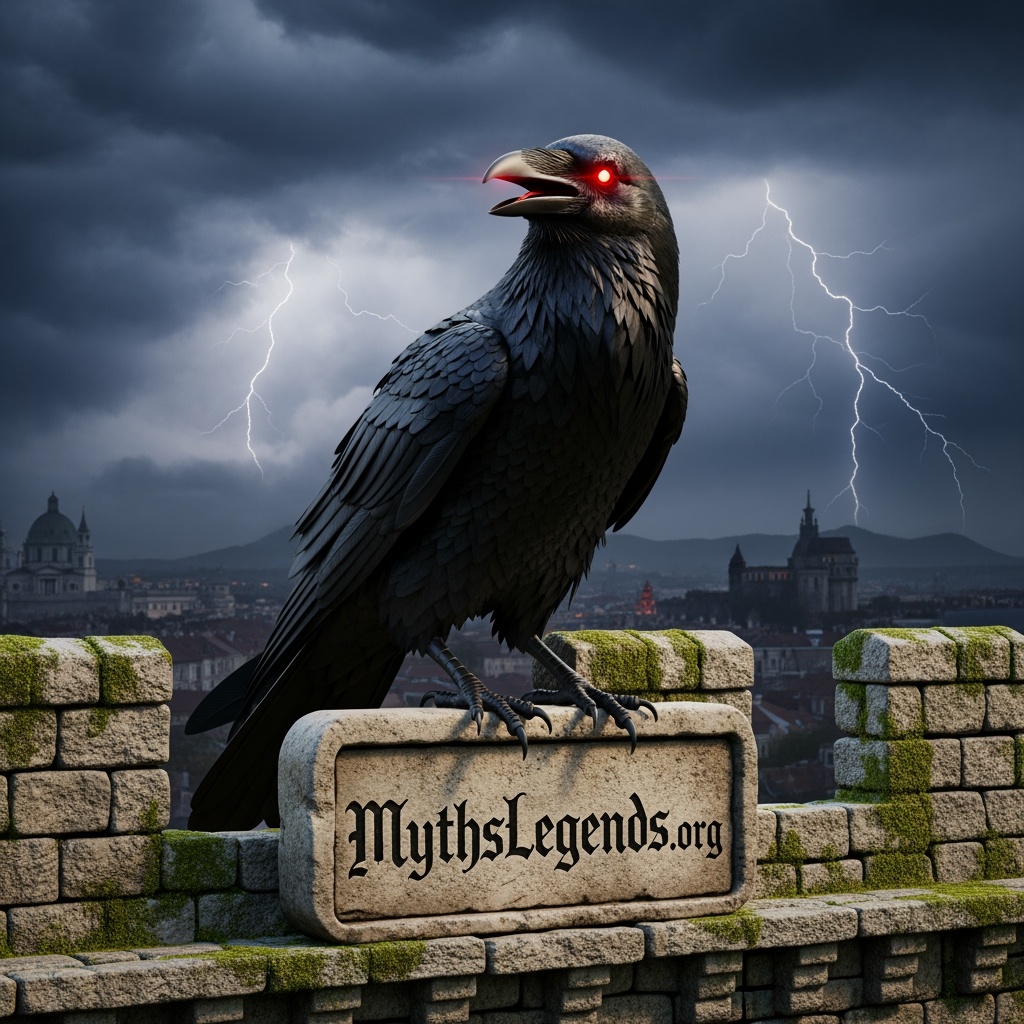
The Black Raven: An Ominous Prophecy from a Dark Past
The story of Count Ulrich of Celje is one of those legends that cast a shadowy veil over history and raise questions about fate, superstition, and dark omens. A sinister symbol that plays a central role in this story is the black raven—an ominous creature whose appearance is often associated with death and doom. According to legend, this bird foretold a tragic end for the count before the Battle of Belgrade, before it ultimately came to pass. But what lies behind this myth? Is it merely a product of human imagination or an expression of deep-seated fears? Let’s delve into the world of mysterious omens and enigmatic events.
The Count and His Era – Count Ulrich II of Celje, a nobleman from one of the most prominent families of medieval Europe, was known for his political ambition and military prowess. The County of Celje, located in present-day Slovenia, was a center of power and influence during its heyday. Ulrich was a colorful figure whose life was marked by intrigue, feuds, and power struggles. Yet history remembers him not only as a political figure but also for the enigmatic prophecy that allegedly haunted him. In 1456, Ulrich moved to Belgrade to fight alongside John Hunyadi against the Ottomans. This battle was to mark a turning point for the count—not in the sense of a triumphant victory, but as the beginning of his downfall. Even before he set out, legend tells of an eerie encounter: a black raven is said to have suddenly perched on the windowsill of his chamber and stared intently at him with its dark eyes. Some claim the raven let out a blood-curdling caw that sounded like a curse. For the people of that time, the black raven was already considered a harbinger of death and misfortune—a symbol that evoked fear and awe.
The Mysterious Meaning of the Black Raven – Why the black raven, of all things? In many cultures, this bird represents the uncanny like no other. In Norse mythology, too, ravens are closely associated with dark prophecies and death. Odin, the chief god of the Edda, owns two ravens, Hugin and Munin, who bring him news from the world—often of doom and destruction. In other European fairy tales and myths as well, the black raven appears as an eerie companion capable of foreseeing destinies. One scientific explanation could be that ravens are extremely intelligent animals often found near battlefields and cemeteries. Their presence in such places reinforced the belief in historical times that they could perceive something “supernatural.” Nevertheless, their reputation as harbingers of death is deeply rooted in the cultural psyche, which lends additional weight to the legend surrounding Count Ulrich.
The Fatal End in Belgrade – The grim foreboding that the black raven supposedly brought came true in a cruel way during the Battle of Belgrade. The conflict between the Crusaders and the Ottomans raged bloodily. While Johann Hunyadi was a strategic genius who organized the city’s defense, Count Ulrich, driven by his determination and pride, rode straight into the thick of the battle. But amid the chaos, he was stabbed in the back by a traitor from within his own ranks. A cruel end that not only shook one of Europe’s most powerful families but also caused the legend of the ominous black raven to grow further.
Superstition or Truth? – The story of the black raven and Count Ulrich’s tragic end raises many questions. Was the bird truly a harbinger? Or is it merely an interpretation through which the people of that time explained the events? After all, belief in omens and signs was deeply rooted in the medieval world. Unusual animal behavior, a sudden change in nature, or unexplained noises were often interpreted as messages from a higher dimension. Modern historians, too, view such accounts with skepticism. Some argue that the legend of the black raven was added later to emphasize the tragedy and drama of Ulrich’s death. On the other hand, there is also the possibility that the raven actually existed—albeit without any connection to the subsequent events. People projected their fear of the unknown onto this animal, and thus it became a symbol of misfortune.
The Black Raven in Pop Culture – The fascination with the black raven has continued into the modern era. Edgar Allan Poe, one of the most famous figures in fantasy literature, immortalized the bird in his poem “The Raven.” In this dark ballad, the raven visits the protagonist and becomes a symbol of the pain of grief as well as the inescapable reality of death. The figure of the raven also appears repeatedly in films, television series, and works of art—as a mysterious observer or as the embodiment of evil.
A Warning from the Past – The story of the black raven and the tragic fate of Count Ulrich continues to fascinate to this day. It bears witness to the deep connection between myth and reality that runs through our history. The raven becomes the silent bearer of a message—whether it is merely a creature of nature or a medium of the supernatural. For the count, the warning was in vain; but for posterity, it remains a reminder to always critically question the boundaries between superstition and reason. Perhaps it is precisely these stories that remind us that the dark forces we sometimes encounter do not always lie outside ourselves. And who knows—perhaps one day the black raven will alight on our windowsill to remind us of transience.













Post Comment