Palamedes: The brilliant inventor caught between myth, war and cultural memory
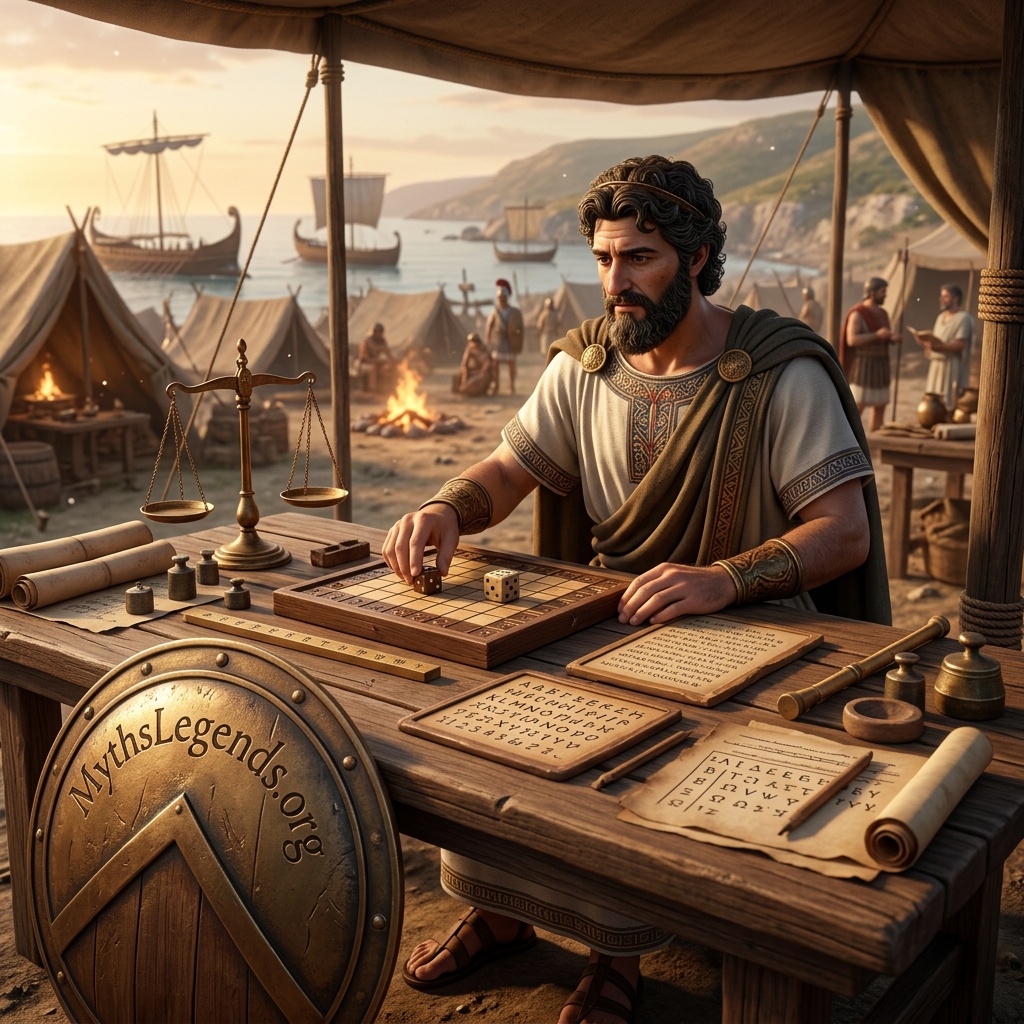
Palamedes is one of the most fascinating figures in Greek mythology – precisely because he is not among the most famous heroes of the Trojan War. Whilst Achilles is known for his fighting prowess, Odysseus for his cunning and Agamemnon for his power, Palamedes stands for something else: intellect, order and inventiveness. Ancient traditions attribute to him the introduction of letters, numbers, measures, weights and games. Even dice and board games are associated with his name. Yet behind this impressive list lies not a historically verifiable biography, but a myth that has evolved over the centuries. Palamedes should therefore be understood less as an ‘inventor’ in the modern sense. Rather, he embodies a central concept of the Greeks: that culture, knowledge and rules are not to be taken for granted, but are created or imparted by extraordinary individuals. His story is also that of a man whose wisdom made him famous – and ultimately led to his downfall.
The son of Nauplius and the wisest man in the army – In mythology, Palamedes is usually regarded as the son of Nauplius, a king of Euboea, and Clymene. His very origins link him to the sea, to trade and to the world of seafaring. In later ancient traditions, Nauplius appears as a tragic figure seeking to avenge his son’s death. Palamedes himself, however, is described above all as an exceptionally wise, just and far-sighted man. He owes his fame primarily to his role in the context of the Trojan War. According to tradition, when the Greek princes set out on their campaign against Troy, Odysseus attempted to evade his duty. He is said to have feigned madness: he ploughed his field and sowed salt to give the impression that he had lost his mind. Palamedes saw through the deception. In a particularly drastic version of the tale, he places the young Telemachus, Odysseus’s son, in front of the plough. Odysseus steps aside so as not to harm his child – thereby proving that he is not mad. He is forced to join the army.This episode, known primarily from later sources and dramatic adaptations, lays the foundation for the enmity between the two men. Palamedes unmasks Odysseus, the master of deception. Thus, the supposedly all-knowing hero himself becomes the one who is outwitted. In many versions of the legend, Odysseus never forgets this humiliation.
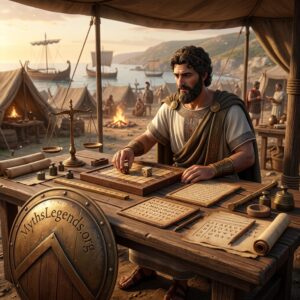
Inventor of writing, numbers and games – Palamedes is particularly noteworthy for the inventions attributed to him. Ancient authors already attributed a whole series of cultural innovations to him. These include parts of the Greek alphabet, numbers, weights and measures, as well as military signals, guard duties and board games. The Roman writer Hyginus names Palamedes as the inventor of eleven Greek letters. Other traditions emphasise his role in the introduction of numerals and in organising daily life. The Greek rhetorician Philostratus describes him as an exceptionally versatile cultural innovator. According to him, Palamedes not only invented games and symbols, but also created structures that facilitated communal life within the army. From today’s historical perspective, these attributions cannot, of course, be taken literally. The Greek alphabet did not come into being through the actions of a single hero. It developed through contact with the Phoenician script and was adapted by various Greek communities over the course of the early first millennium BC. Measures, weights and number systems, too, are the result of long-term social and economic developments. This is precisely why the legends about Palamedes are so revealing. They show how the Greeks reflected on the origins of their culture. Where do written characters come from? Who brings order to an army? Who transforms a pastime into a game with rules? The myth answers these questions not with an anonymous process, but with an outstanding individual. Palamedes is thus a mythical distillation. His figure brings together many inventions that were important for education, trade, administration and warfare. He embodies the idea that intelligence consists not only in outwitting an opponent strategically, but also in creating rules, symbols and systems.
Board games, dice and the connection to Tavli – Particularly popular is the notion that Palamedes invented dice or board games. Later Greek and Roman sources recount that, during the siege of Troy, he devised games to keep the soldiers occupied and dispel their boredom. This tradition is often linked to the ancient game “petteia”, a board game whose exact rules can no longer be fully reconstructed today. Modern interpretations sometimes draw a connection to “tavli”, the family of board games widespread in Greece that is related to backgammon. Caution is advised, however: “tavli” and backgammon in their present-day forms are considerably more recent gaming traditions. They cannot be directly traced back to Palamedes. Rather, the mythical attribution generally refers to the invention of strategic board and dice games. It is no coincidence that a military commander or adviser, of all people, is regarded as the inventor of such games. In antiquity, games were not merely a form of entertainment. They could symbolise tactical thinking, patience, calculation and the handling of chance. On a game board, planning and risk go head to head – qualities that are also decisive in war. The connection between Palamedes and games therefore makes him a figure straddling the boundary between seriousness and leisure. He organises the war, yet at the same time he devises ways to combat the monotony of camp life. He embodies the spirit that creates order and intellectual challenge even under extreme conditions.
Death by intrigue – The greatest tragedy of the Palamedes legend lies in the fact that his cleverness does not protect him. On the contrary: it makes him a target. Whilst the Greeks were besieging Troy, Odysseus is said to have conspired against him together with other adversaries. In the best-known version, a forged letter is planted, purportedly from the Trojan king Priam. To this end, the conspirators place gold in Palamedes’ possession or in a place that can be linked to him. The evidence is intended to show that Palamedes is collaborating with the Trojans. The Greeks believe the accusation, and Palamedes is sentenced to death – often by stoning. The tradition includes various versions. In some, Odysseus is explicitly named as the main instigator; in others, Diomedes or Agamemnon are also involved. What they all have in common is that Palamedes does not die because of any actual guilt, but as the victim of a deception. The man who had recognised Odysseus’s deception is himself destroyed by a deception. This reversal lends the story its particular power. Palamedes is a hero of reason, yet the community he serves does not act rationally. It allows itself to be swayed by apparent evidence. His story is therefore also an early tale of slander, political intrigue and the vulnerability of truth.
A Counterpoint to Odysseus – Palamedes is often interpreted as a counterpoint to Odysseus. Both are regarded as intelligent, but their intelligence takes different forms. Odysseus embodies “metis”, that flexible, situational cunning which manifests itself in deception, adaptation and surprising twists. Palamedes, on the other hand, stands more for organised knowledge: for writing, numbers, rules and comprehensible procedures. The conflict between the two is therefore more than a personal enmity. It pits two kinds of wisdom against one another. Odysseus frequently prevails through cunning; Palamedes establishes lasting order. Yet ancient literature is by no means uniform in its assessment. In Homer’s “Iliad” and “Odyssey”, Palamedes plays no role. His great significance developed primarily in later narratives, in tragedy, amongst mythographers and orators. It was precisely this later portrayal that made him an attractive figure. For authors and philosophers, Palamedes offered the opportunity to reflect on justice and power. He was the innocently persecuted man whose abilities were not rewarded but punished. In modern times, his story has therefore repeatedly been interpreted as an example of the conflict between truth and political expediency.
Myth rather than historical biography – It is highly likely that Palamedes was not a historical figure whose achievements can be verified archaeologically or through documentary evidence. His character belongs to the realm of Greek heroic legend. Nevertheless, it would be wrong to dismiss the myth as mere fantasy for that reason. Myths do not preserve modern factual accounts, but they convey the ideas, values and conflicts of their time. The story of Palamedes illustrates just how much writing, numbers and orderly conduct were regarded as signs of civilisation. It also shows that knowledge can be ambivalent: those who understand more than others are not automatically protected. On the contrary, their superiority can arouse mistrust and envy. Palamedes, the ‘brilliant inventor’, therefore remains a multi-faceted figure. He is not a verifiable inventor of the alphabet or backgammon. Yet, as a mythological bearer of culture, he stands for something enduring: the desire to narrate the origins of human order, education and inventiveness through a single extraordinary figure.


















Post Comment