
The Legend of the Stag and the Broken Wheel: A Fascinating Symbol of Červený Kameň Castle
Červený Kameň Castle, also known by its German name Bibersburg, stands majestically in the west of Slovakia. It is not only an architectural gem with a rich history, but also a treasure trove of legends and myths that have entwined themselves around its walls for centuries. Among these tales, one legend in particular stands out, deeply rooted in the history of the noble Pálffy family: the legend of the stag and the broken wheel. This story impressively combines courage, fate and a mysterious symbol that still features on the family’s coat of arms to this day.
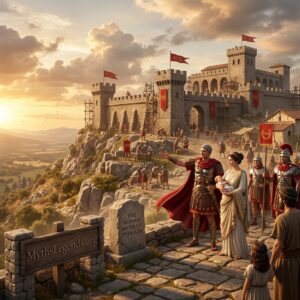
The Historical Setting: Červený Kameň Castle and the Pálffy Family – To understand the significance of the legend, it is worth taking a look at the background of the castle and its famous inhabitants. Červený Kameň Castle was built in the 13th century and was strategically important for controlling the trade routes through the Slovak highlands. Over the centuries, it belonged to various noble families until it came into the possession of the Pálffy family at the end of the 16th century. The Pálffys were one of the most influential noble families in the Kingdom of Hungary (now part of Slovakia) and played a decisive role in shaping regional politics and culture. The family was renowned both for its military campaigns against Ottoman troops and for its patronage of the arts and architecture. This combination of fighting spirit and cultural commitment is also reflected in the symbolic legend that remains part of the collective memory surrounding the castle to this day.
The Legend in Detail: Stag, Carriage and Broken Wheel – The legend tells of a night when members of the Pálffy family were travelling by carriage through the dense forest near the castle. The darkness was impenetrable, and the track impassable – a dangerous undertaking in an era without street lighting or modern infrastructure. Suddenly, a large stag leapt out of the thicket. Its unexpected appearance forced the carriage to a halt. In the process, one of the carriage wheels broke, which at first seemed like a misfortune. The travellers were forced to spend the night in the forest. The next morning, however, the true extent of the danger became apparent: the carriage was standing right on the edge of a deep precipice, whose sheer rock faces would have made it impossible to continue. Had the carriage carried on along the path, it would have plunged into the abyss, and the travellers’ fate would have been sealed. The stag had literally saved them from death. The animal appeared as a guardian spirit or a sign of providence by halting the carriage and thus preventing a catastrophic accident.
The symbol in the coat of arms: a stag with a broken wheel – In recognition of this miraculous event, the stag with the broken wheel soon became part of the Pálffy family’s coat of arms. The symbol is extraordinary, as it combines both the danger and the broken wheel, as well as the rescuing stag. Heraldry experts see in this emblem a successful fusion of life and fate, of danger and rescue. The stag, as a symbol of vigilance, speed and yet a peaceful nature, meets here the broken wheel, which is interpreted as a symbol of movement brought to a halt or of danger averted. This coat of arms became widely used as the family’s distinguishing mark and, to this day, serves as a reminder of the legend, which has not only been passed down orally from generation to generation but has also been immortalised in artistic depictions.
Further Sources and Parallels in Mythology – The legend of the stag as a saviour has parallels in other European myths and sagas. In Celtic and Germanic culture, the stag is often regarded as a mediator between the worlds, a guardian of nature and a companion to souls. In Christian symbolism, too, the stag stands for purity, renewal and divine guidance. The fact that a stag in particular appears near Červený Kameň Castle adds a further symbolic dimension to the legend. The connection to nature and supernatural forces elevates the story far beyond a mere anecdote. Historical records from the 17th and 18th centuries, such as the chronicles of the Pálffy family and regional annals, confirm the telling of this event, albeit in different versions. Yet the core of the story remains consistent: the sudden appearance of the stag and the broken wheel as a sign of salvation.
Significance for the region and modern-day perception – Today, Červený Kameň Castle is not only a popular tourist destination but also a place where history comes to life. Guided tours, exhibitions and events often draw on the legend of the stag and the broken wheel to give visitors a sense of the castle’s mystical atmosphere. Some of the museum’s exhibits are replicas of the famous coat of arms and explain its origins. The story inspires artists and authors alike, as it offers a thrilling mix of real danger, a fateful encounter and symbolic significance. Furthermore, the castle houses an extensive collection of historical weapons, furniture and works of art, which brings to life the world of the Pálffy noble family at that time and thus embeds the legend in its historical context.
Legends as a bridge between the past and the present – The legend of the stag and the broken wheel impressively demonstrates how stories with symbolic content can forge a sense of identity. It combines historical facts with mythical motifs, thereby creating a powerful image that continues to fascinate to this day. For Červený Kameň Castle, this legend is more than just a tale – it is part of the cultural heritage that captivates visitors and keeps the region’s history alive. The combination of actual historical circumstances and the mythical dimension of the stag makes the legend a fascinating document of the European cultural landscape.



Post Comment