
The Altar of the Winds: A sacred site of ancient gods and seafaring legends
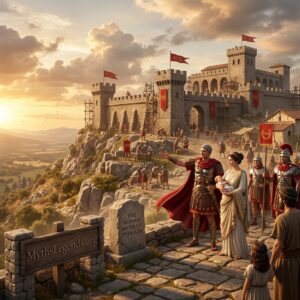
Today, a Byzantine fortress stands atop a hill on the shores of the Black Sea; its walls have borne witness to numerous historical events for centuries. Yet long before the Byzantines built the castle here in the 13th century, this hill was already a place of great spiritual significance – not only for the local peoples, but also for the seafarers of antiquity. Set against this historical backdrop is the legend of the so-called ‘Altar of the Winds’, a place of worship where ancient peoples such as the Phoenicians and Greeks paid homage to the gods of the wind and the sea, praying for safe journeys across the often treacherous Black Sea. This article sheds light on the fascinating history of this sacred site, its mythological significance and the background to the worship of Zeus Ourios – the god of favourable winds.
A sacred site even before the Byzantine era – The region surrounding the castle’s present-day location was already regarded as religiously significant in antiquity. Archaeological finds and historical accounts suggest that the Phoenicians, and later the Greek colonists, maintained a place of worship here. As a natural landmark, the hill offered an ideal vantage point for observing wind directions and weather phenomena, which was of central importance to a society heavily dependent on maritime trade and navigation. The Phoenicians, renowned as masters of seafaring, had already used the site to pray to their gods for protection. The Greeks adopted and expanded upon this tradition by erecting a temple here dedicated to Zeus Ourios. This god was no ordinary figure in the Greek pantheon: he symbolised not only the wind, but above all the favourable wind that aided sailing – a vital force for ancient seafarers.
Zeus Ourios: The God of Favourable Winds – In Greek mythology, there were numerous winds that were personified and worshipped. However, Zeus Ourios was a specific aspect of the mighty Zeus, who is normally known as the ruler of the heavens and thunder. The epithet ‘Ourios’ derives from the Greek word ‘ourios’ (ὄυριος), meaning ‘eastern’ or ‘favourable’, and is often associated in this context with pleasant, benevolent winds. Whilst other winds heralded storms and destruction, Zeus Ourios represented those gentle breezes that ensured a safe passage for seafarers. The cult of Zeus Ourios at this site was therefore closely linked to seafaring and the hope for divine protection. Legends recount that, before embarking on the often perilous journey across the Black Sea, seafarers would stop here to make offerings. They hoped for the god’s intervention, which would ease their journey through favourable winds. This practice was by no means unusual, as in the ancient world such offerings were an integral part of travel preparations.
Origin of the name ‘Yoros’ – Interestingly, the town’s present-day name, ‘Yoros’, is also thought to be linked to these ancient cult practices. Linguistic studies suggest that ‘Yoros’ is derived from the Greek word ‘Ourios’ or may be related to ‘Hieron’ (ἱερόν), which means ‘sacred place’. Both terms reflect the spiritual significance of the site in ancient thought. Thus, the name of the hill has a deep connection to its historical function as a ritual gathering place for those who sought to master the sea.
The Significance of Wind Worship in Ancient Seafaring – In antiquity, wind played a crucial role in navigation. Without modern technology, seafarers were at the mercy of the weather. A sudden storm could cause a ship to capsize, whilst a favourable wind enabled a swift and safe journey. For this reason, winds were not merely meteorological phenomena, but were regarded as divine powers that had to be invoked and appeased. In many ancient cultures, there were therefore specific cults dedicated to individual wind directions or wind gods. Ancient Greece, for example, had the Anemoi, the wind gods, each of whom was associated with a cardinal direction and embodied different characteristics. Of particular importance here, however, was Zeus Ourios, who represented the favourable east winds. Sailors brought offerings with them to implore a favourable wind direction. This often took the form of animal sacrifices, incense offerings or the presentation of food and valuable objects. Some sources report that, particularly at places such as this ‘Altar of the Winds’, a ritual ceremony took place that was motivated by both gratitude and fear of the forces of nature.
Further sources on the legend and significance – The significance of the Altar of the Winds is not only recorded in local legends, but is also reflected in written sources by ancient historians and geographers. For example, the Greek writer Strabo mentions in his work *Geographika* a place of worship on the Black Sea coast dedicated to the guardian deities of the sea and the wind. Whilst it is not entirely clear whether this refers specifically to today’s ‘Yoros’, the description fits well with the traditional legend. Archaeological investigations in the region have also uncovered evidence of ritual use. The remains of temple ruins, altars and sacrificial sites attest to the hill’s religious significance. The finds suggest that the site played an important role, particularly during the Hellenistic period, and may even have been a major place of pilgrimage. In the Middle Ages, the site’s original function was supplanted by the construction of the Byzantine castle, yet the memory of its spiritual origins remained alive amongst the local population. Legends and tales about the ‘holy place’ and the protection of the winds gave people confidence in the face of the dangers of the sea.
A mystical place between myth and history – The Altar of the Winds is more than just a legend: it bears witness to how ancient cultures interpreted their environment and sought to come to terms with the forces of nature. The worship of Zeus Ourios symbolises a deep belief in a higher power capable of coming to people’s aid. In particular, its connection to seafaring makes the site an important cultural relic that continues to fascinate to this day. This heritage illustrates just how dependent ancient peoples were on the sea and the rituals and myths that arose from this dependence. The name ‘Yoros’ remains a silent witness to this rich history, which lies at the intersection of religion, navigation and human hope. Whilst today’s castle may dominate the visible landscape, the invisible traces of the ‘Altar of the Winds’ continue to resonate in legends, place-names and the knowledge of a time when the gods and the forces of nature were still very close at hand.






Post Comment