
The story of ‘Bläsi’: Feldkirch’s legendary little knight in St John’s Church
Nestled in the picturesque region of Vorarlberg in Austria, the town of Feldkirch exudes a very special charm with its medieval architecture and rich history. Among its many treasures is St John’s Church, a place steeped in centuries of tradition and mystery. At the heart of a local legend is “Bläsi”, a peculiar figure said to dwell high above the town in the church’s roof tower – a tiny knight who comes to life under the cover of night and wields his trusty battle-axe. But who is this enigmatic figure, and what draws locals and visitors alike to search for him in Feldkirch’s night sky?
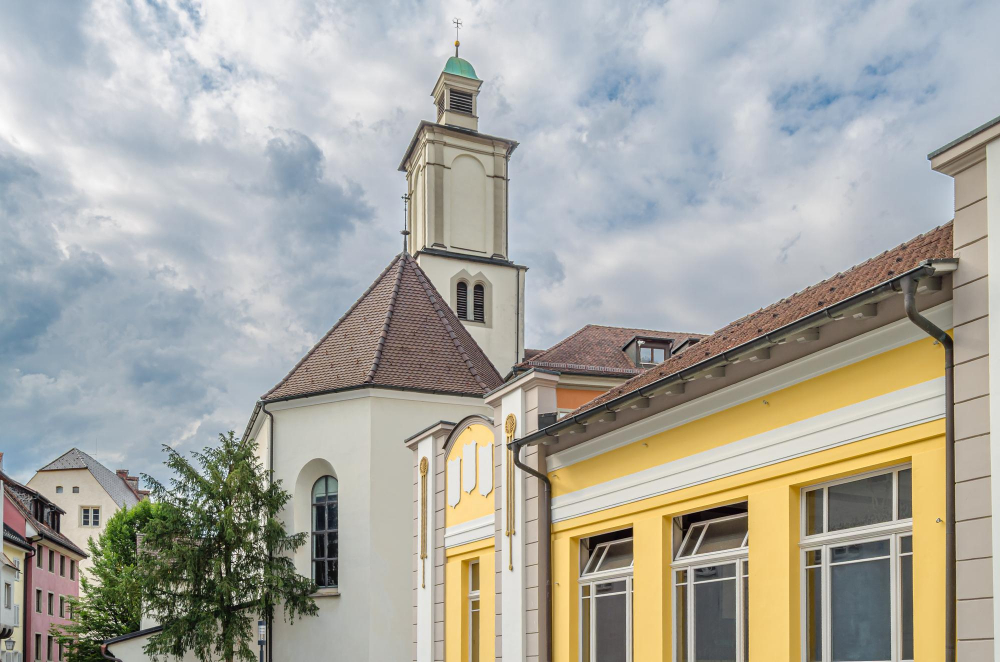
A strange guardian over the town – St John’s Church is both a spiritual centre and a symbol of Feldkirch’s deep-rooted history. The church was built in the early 13th century by the noble Order of St John and has long been interwoven with tales of knights and chivalry. None, however, is as curious as that of Bläsi, a tiny knight who is said to dwell quietly in the roof turret. Legend has it that Bläsi appears after sunset and descends from his perch, battle-axe firmly in hand. His mission? To strike the hours on a bell in the tower, so that the rhythm of time echoes through the sleeping town. Some locals describe him as a watchful guardian, whose presence serves both as a protector of Feldkirch and as a link to the town’s medieval roots. Others see him merely as a folk tale, born of people’s love of storytelling and their fascination with the mysteries of the night. When the hour strikes, Bläsi is said to swing his axe with precision, each blow producing a sound that echoes through Feldkirch’s cobbled streets. Even though no one has claimed to have witnessed this ritual first-hand, the undeniable charm of the story secures it a place in the city’s collective imagination.
Origins of the Legend: Fact or Fiction? – As with many such myths, the origins of Bläsi’s story lie in the dark. Historians speculate that it may be linked to the practical mechanisms of medieval clock towers, which often employed figures or automata to mark the passing hours. Across Europe, symbolic figures, ranging from angels to soldiers, were incorporated into the design of clocks to ring bells and signal the time to the communities below. Perhaps the story of Bläsi arose to lend Feldkirch’s own clock tower a touch of mystique. Yet, unlike other clock figures, Bläsi is not described as an automaton, but as a living, mythical being. The name ‘Bläsi’ itself offers clues to the story’s origins. It could be derived from ‘Blasius’, a saint popular in medieval Europe who is associated with protection and healing. Alternatively, the name might simply reflect the local dialect or colloquial expressions, lending a personal touch to the figure’s identity. Regardless of its etymology, the legend of Bläsi seems to embody the spirit of Feldkirch – a blend of medieval tradition and whimsical fantasy.
A symbol of chivalric virtues – To understand why Bläsi is so popular with the people of Feldkirch, it is helpful to consider the symbolic significance of knights in Austrian folklore. Knights represent bravery, loyalty and a sense of duty – qualities that communities often admire and aspire to emulate. By embodying these virtues, Bläsi becomes more than just a whimsical figure; he represents values that are central to the town’s identity. Furthermore, Feldkirch’s links to the Order of St John reinforce the thematic significance of knights. The Knights of St John were renowned for their commitment to charity and their defence of the Christian faith. Could Bläsi’s nightly ritual be seen as a continuation of this protective legacy? For some, the image of the little knight tirelessly treading water evokes associations of steadfastness and responsibility – a reminder that even the smallest among us can make a significant contribution.
Feldkirch’s enduring love of legends – One reason for the enduring popularity of Feldkirch’s legends may lie in the town’s commitment to commemorating its past. Local tour guides often recount stories such as Bläsi’s alongside historical anecdotes, blending facts with folklore to create captivating narratives for visitors. In a world increasingly shaped by technology and modernity, these stories offer a glimpse into a simpler, more enchanting time. Furthermore, the legend of Bläsi lends a special uniqueness to Feldkirch’s cultural identity. Whilst many towns across Europe boast of ancient churches and chivalric traditions, few can tell of a mythical figure like Bläsi who strikes the hours from their bell towers. In this sense, Bläsi serves as a unifying symbol for Feldkirch, celebrating both its individuality and its shared heritage.
Beyond the Myth: Architectural Masterpieces – Whilst Bläsi captures the imagination, the Johanniterkirche itself deserves attention for its architectural and historical significance. Its Gothic features, intricate carvings and stained-glass windows bear witness to centuries of craftsmanship. The ridge turret, in which Bläsi is said to dwell, lends the church building a distinctive flair. Ridge turrets such as this were widespread in medieval ecclesiastical architecture and often served functional purposes whilst simultaneously enhancing the visual aesthetics. Some speculate that the strategic location of the ridge turret may have contributed to the emergence of the Bläsi myth. Perched high above the town, the tower appears detached from the reality below – an ideal setting for a tale of magical beings. As dusk falls and the shadows lengthen, it is easy to see how stories of nocturnal knights could have emerged in such an atmospheric setting.
Preserving the legend for future generations – In recent years, Feldkirch has taken steps to preserve its cultural heritage, including its oral traditions. At events and festivals, stories such as that of Bläsi are occasionally incorporated into performances to keep the narrative alive for younger generations. Tourists visiting Feldkirch are often encouraged to explore local legends alongside the historical sights, offering a multifaceted experience that blends history, culture and myth. Modern interpretations of Bläsi’s story have also found their way into art and literature. Illustrators have imagined the tiny knight in action, his armour glinting in the moonlight as he raises his axe. Writers have adapted the legend into poems and short stories, weaving elements of adventure and mystery into Bläsi’s nocturnal routine. These reinterpretations ensure that the legend lives on not merely as a memory, but as a dynamic part of Feldkirch’s cultural identity.
A timeless story – The legend of Bläsi, the little knight of Feldkirch, continues to fascinate and delight all who encounter it. Whether viewed as a charming folk tale or a reflection of medieval traditions, Bläsi embodies the unique spirit of Feldkirch: a city that harmonises history and myth, reality and fantasy. High above the town, enthroned in the roof tower of St John’s Church, Bläsi remains a folkloric guardian who strikes the hours and watches over the night. Even though no one has ever seen him in action, his presence lives on in the hearts and minds of Feldkirch’s residents, reminding them of their history-steeped past and their enduring connection to the extraordinary. As visitors stroll through the winding alleys of Feldkirch, they may pause at dusk beneath the Johanniterkirche and listen intently to the soft tolling of a bell. Is it merely the wind echoing through the tower – or could it be Bläsi, once again fulfilling his age-old duty? In Feldkirch, anything seems possible when legends come to life.









Post Comment