
The Legend of the Munich Pretzel Rider
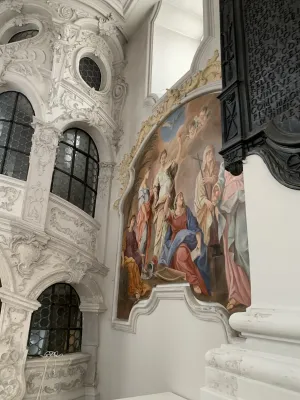
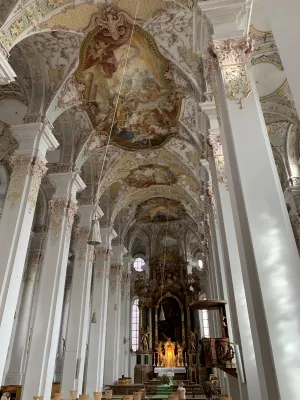
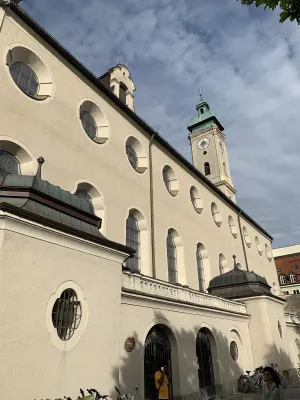
One of Munich’s oldest surviving sacred buildings is the Heilig-Geist-Kirche im Tal (Holy Spirit Church in the Valley). This Catholic parish church is located right next to the legendary Viktualienmarkt. The church was built on the site of the former hospital that Duke Ludwig I of Kehlheim had built in 1208 at the Thalburgtor, today’s tower of the Old Town Hall. The hospital, which also had a chapel dedicated to St. Catherine of Alexandria, was enlarged several times. However, it burned down completely, along with the chapel, in the devastating city fire of 1327. A Gothic hall church was then built, its construction completed in 1392 by master builder Gabriel Ridler. The church received its Baroque interior between 1724 and 1730 from Johann Georg Ettenhofer and the Asam brothers. In the course of further renovation work in 1844, the church was elevated to the status of parish church for the town. The church suffered severe damage during the Second World War. The spire, the roof truss, the nave, and the sacristy were completely destroyed. Only the façade remained. It was rebuilt between 1946 and 1952. Under the architect Erwin Schleich, the interior with its high altar and impressive frescoes by the Asam brothers was reconstructed. The church received a special honor in 2012 when a fourth bell, the so-called Brezenreiter Bell, was added to the three existing bells named Heiliggeist, Maria, and Josef. According to legend, this bell was named after the Wadler family of Munich merchants, who founded a foundation for feeding the poor in 1318 and had pretzels distributed to the needy once a year by horsemen. Until 1801, over 3,000 pretzels were donated to the needy every year. However, this wonderful custom came to an end after more than 483 years because the rider did not have enough pretzels with him and was subsequently thrown from his horse and beaten up. Today, a ceiling fresco by Cosmas Damian Asam and the Pretzel Rider Bell commemorate this tradition. For this reason, a pretzel and a Latin inscription are affixed to the front of the bell. Incidentally, every year on Munich’s city anniversary, a pretzel rider rides through the city with a basket of pretzels, and anyone can purchase a pretzel from the Munich citizens for a small donation to social institutions. Along with beer and white sausage, pretzels are simply part of Munich. According to legend, pretzels were first eaten there on February 11, 1839. At that time, Wilhelm Eugen von Ursingen, a royal Württemberg envoy, wanted to stop at a Munich café to eat a pretzel. However, pretzels used to be made sweet. Pretzels got their typical lye today due to a mistake by baker Anton Nepomuk Pfannenbrenner, who soaked them in caustic soda instead of sugar water, which was intended for cleaning the baking trays. The pretzel was baked in the oven as usual and came out crispy and brown. The rest is history. This is how the secret to the success of this Bavarian cultural treasure began, and it continues to this day.




Post Comment