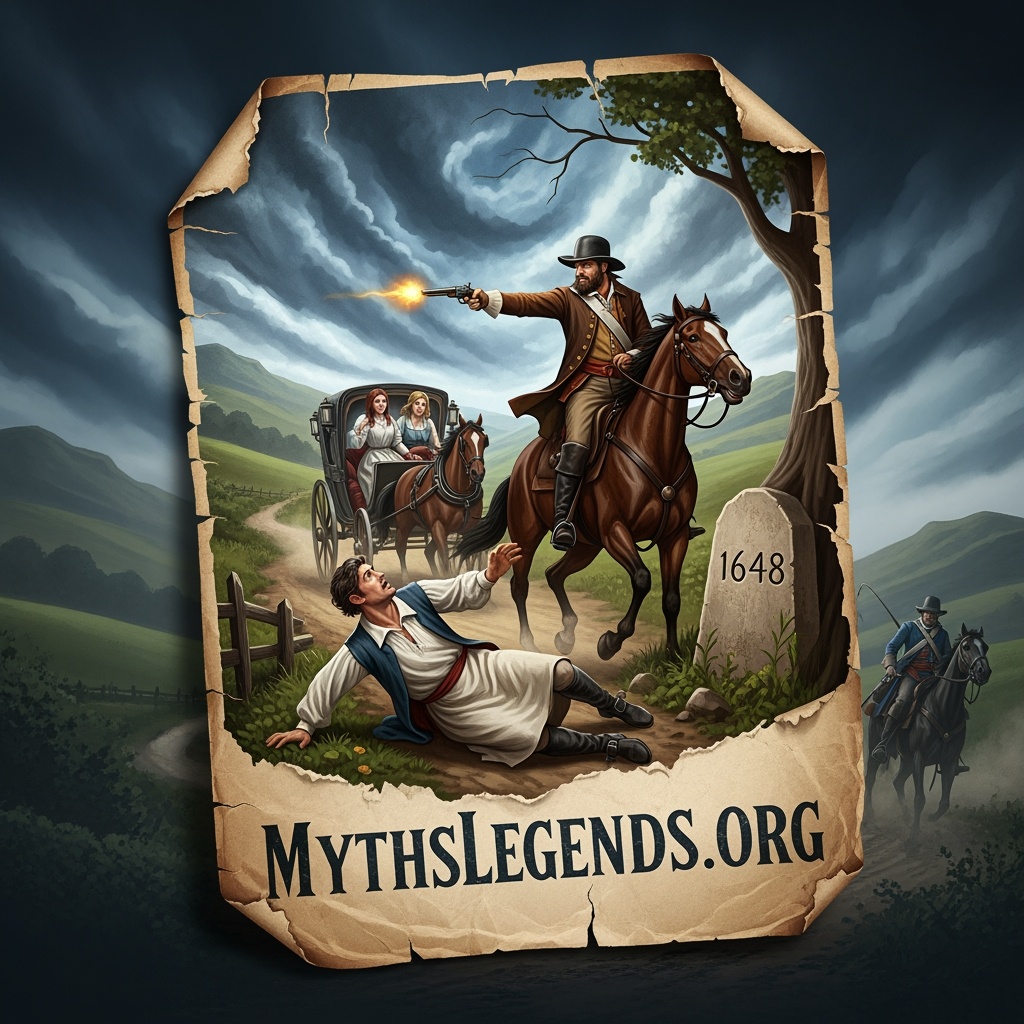
The heroic highwayman
Ever since Robin Hood stole from the rich to give to the poor, Great Britain has been considered the land of heroic robbers. One of these was Captain James Hind, as the people called him. He went down in English criminal history as a 17th-century royalist highwayman. James Hind was born as the only son of the respected and devout saddler Roger Kynaston and Elizabeth Gray in the town of Chipping Norton in the county of Oxfordshire. James’ father did everything he could to provide his son with a good education. After graduating from school, James began an apprenticeship with a butcher at the age of 15. But apprenticeships are not easy years. James experienced this firsthand, dropping out after two years due to his strict master. He now wanted to try his luck in London and traveled there. In a letter, he asked his mother for money so that he could find a new master in London. She sent James a handsome sum, which James invested in loose women rather than his education. While visiting one such lady, he was arrested along with her because she had stolen from her client the night before. While the woman had to spend a night in Newgate Prison, James was released. That night, he met street thief Thomas Allen, who had been arrested on suspicion of theft. A short time later, he was released due to lack of evidence. The men struck up a conversation and sealed their newfound friendship that night with a pact, which they toasted. Thomas became James’ new mentor in the art of street robbery. James’ first victim was a traveler he met on the road to Shooter Hill. He robbed him. But when he realized that the loot was not excessive and that the victim still had a long journey ahead of him, he gave him 20 shillings of his loot. The victim was so perplexed that he even thanked James. Thus, the myth of James Hind as a gentleman robber was born. From then on, Thomas and James stuck together like glue. At that time, England was in a state of emergency due to the execution of King Charles I. He had been sentenced to death by the English Parliament as the so-called instigator of the bloody battles of 1649. When he was beheaded on January 30, 1649, the population was outraged, as the future was uncertain with the radicals in Parliament. James and Thomas, like the general population, were shaken to the core. They swore revenge on the regicides who had voted for the king’s death penalty in Parliament. When they heard that Oliver Cromwell was traveling from his birthplace in Hunting to London in a carriage guarded by seven men, they planned an assassination attempt on him. Oliver Cromwell was the leader of the radicals in Parliament, who since 1945 had been trying to get Charles to sign a constitutional order that would restore the balance between Parliament and the Crown. But King Charles I refused and instead sought help from the Scots, who fought on his side in the war in 1648. Oliver Cromwell defeated Charles’s army at Preston. He eventually captured him and pressured Parliament to charge King Charles I with high treason, which resulted in the king’s execution. James and Thomas, as royalists, wanted revenge and attacked Cromwell. But the assassination attempt failed. While James managed to escape, Thomas was arrested and taken to London, where he was executed. Since then, James had been hunted. Then came a fateful encounter with the king’s murderer, Hughes Peters, in Enfield Chase, from whom James stole not only 30 gold pieces, but also his coat and skirt, leaving him to make his way home wearing only his shirt sleeves. James became increasingly popular as a royalist highwayman, and on his way from Sherbourn to Shaftesbury in Yorkshire, he encountered Sergeant Bradshaw. Bradshaw had presided over the commission that sentenced King Charles I to death and pronounced the death sentence against him. James stole a bulging purse containing 40 gold coins from Bradshaw, which would be worth around €4,000 today. Not only did he humiliate him by singing a mocking song about him, he also killed the horses pulling his carriage before riding off. Soon after, James encountered a carriage carrying young ladies between Petersfield and Portsmouth, from whom he stole £1,000. James spent his ill-gotten gains as quickly as he earned them. He was always polite when committing his thefts. He threatened people with his pistols, but never used them. Until he shot a horseman, believing that he had been pursuing him after the robbery of the king’s murderer, Colonel Harrison. But this turned out to be Georges Sympson, a servant who had only been trying to catch up with his master. After this incident, James ended his career as a robber. He volunteered for the royalist army. When the Scots rose up for King Charles’ son, whom they proclaimed King Charles II, and marched into England with a large army, James fought in the Battle of Worcester, the last battle of the English Civil War, which ended in a bloody defeat for the royalists. James fled to his childhood friend Barbier Dingie, who betrayed him. As a traitor, James was taken to Newgate Prison. On September 3, 1652, he was sentenced to death for treason at the Old Bailey in London. On September 24, 1652, he was dragged to the place of execution. James was 36 years old when he was publicly hanged. Afterwards, his body was quartered and his severed head was placed on a grate on the Severn Bridge. The limbs of his body were hung over the city gates of Worcester. They remained there until they were completely decomposed. His head, however, was buried the following night. This ended the life of James Hind, but he lives on today in ballads, books, and films.







Post Comment