The eccentric baron
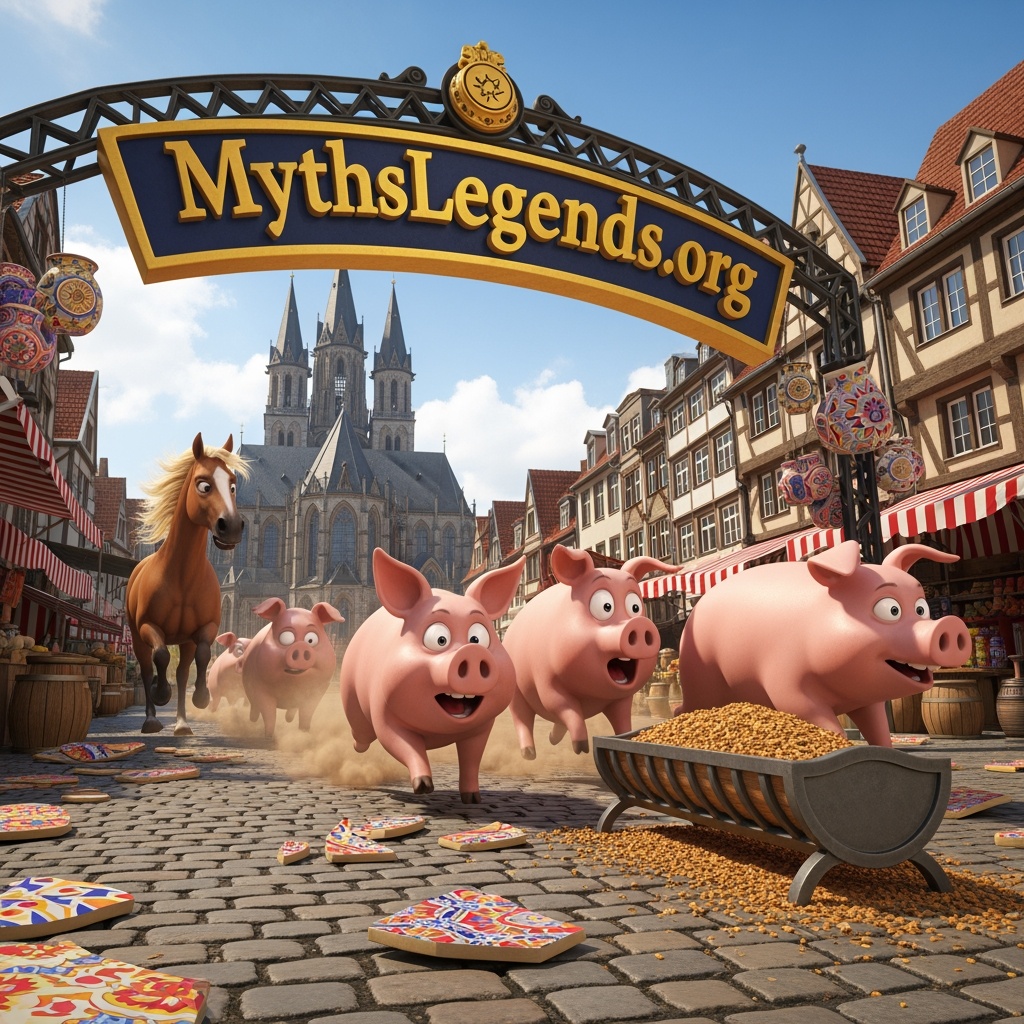
Gisbert von Romberg II, an eccentric baron who loved to play crude pranks on his fellow men, was born on July 20, 1839, in Münster as the eldest son of one of the richest noble families in the Kingdom of Prussia. Gisbert enjoyed an education befitting his status and in 1866 took part in the German War, the feud between the German Confederation and Prussia, as an officer in the Cuirassier Regiment. After his father’s death in 1869, Gisbert took over the family business and, during the Franco-Prussian War, set up a military hospital for the war wounded in Brünninghausen, now a district of Dortmund, where the family had owned a castle and park for over 450 years. But Gisbert von Romberg, who had money to burn, was not only a benefactor, but also known for his escapades. He was a passionate horse lover who spent a lot of money on horse racing and was always up for bizarre pranks. Once he bet that his pigs would win a race against a famous racehorse. To win the bet, he trained the pigs and starved them. During the race, the hungry pigs galloped to the feeding trough. The horse had no chance against the pigs. His ride across the pottery market in front of St. Reinoldi Church in Dortmund is also legendary, during which all the pottery was broken. Gisbert von Romberg could only laugh about it and simply paid the angry market women for the broken goods. Gisbert von Romberg was also known for having fun when he took complete strangers in his carriage. When they gratefully accepted the ride, he would let the horses run wild, so that the carriage raced over hill and dale at breakneck speed. Sometimes the passenger would even fly out of the carriage in a high arc or break all their bones. Gisbert von Romberg himself survived the carriage ride unscathed, perhaps because he always had a drink before the hellish ride. Of course, Gisbert paid for the damage caused. His wife also had to endure these carriage rides, for which she was rewarded with a stay in a hotel suite and beautiful clothes. In inns, Gisbert used to smash everything to smithereens. He would break champagne bottles with his walking stick, so that the sparkling liquid flowed across the floor. Gisbert was a fan of the Dortmund musician Franz Giesenkirchen, whom he not only invited to parties at his castle, only to thank him by hitting him on the head with his top hat, but also had him play a concert when he arrived at Dortmund train station. Gisbert was known for his pranks, which he enjoyed playing together with his friend Hermann Landois, the director of Münster Zoo, as both shared a “love of making fools of the world.” Due to his escapades, his cousins Count Gisbert von Wolf-Metternich and Baron Clemens von Romberg attempted to push through incapacitation proceedings for drunkenness and profligacy before the Dülmen District Court in 1881, as the family inheritance was at stake. However, Gisbert’s lawyers were able to prove that he had actually increased the family fortune despite his extravagant lifestyle. His legendary pranks inspired author Josef Winckler to write the picaresque novel “Der tolle Bomberg” (The Mad Bomberg) in 1923, which was made into a film in 1932 and 1957. This gave rise to the myth of the eccentric Baron Gisbert von Romberg, whose adventures were partly real and partly fictional.





Post Comment