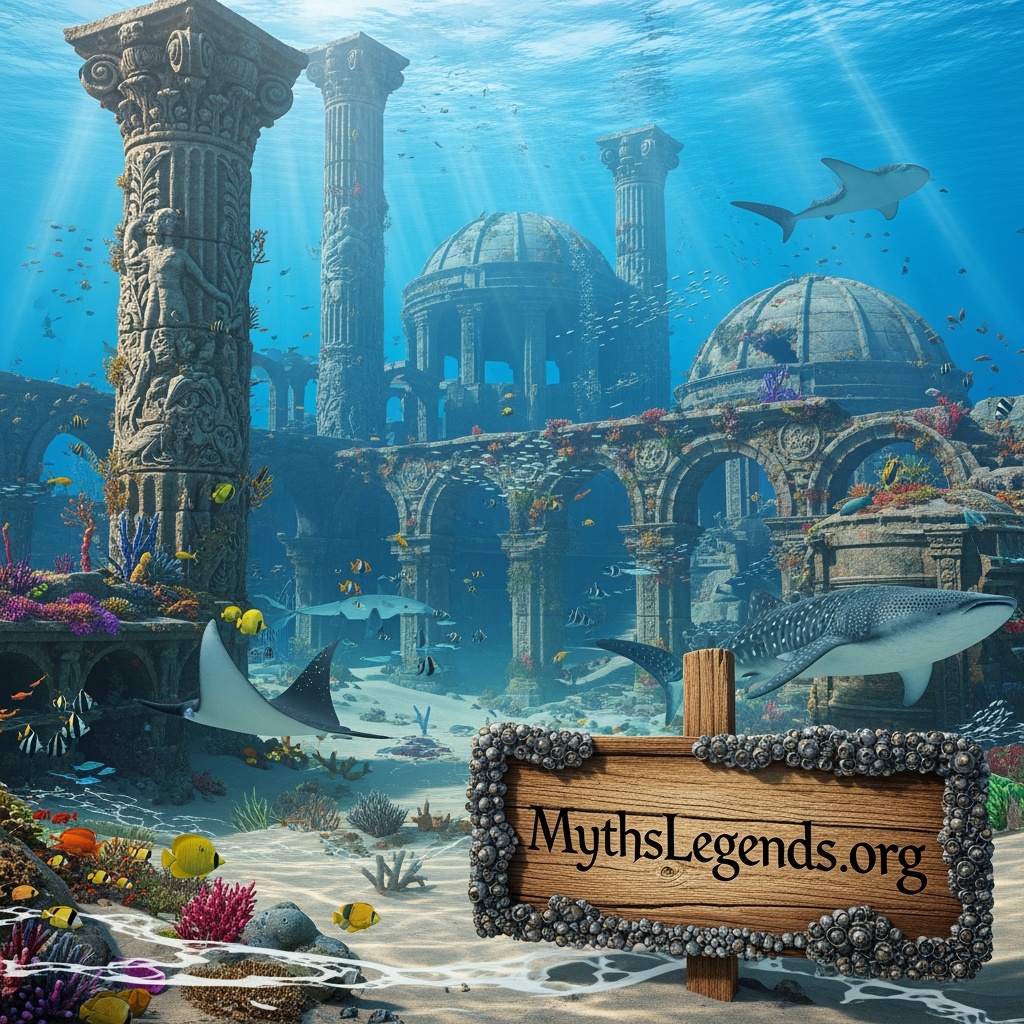
Atlantis Revealed: The Secret Beneath the Waves
For centuries, the legend of Atlantis has fascinated treasure hunters and scientists alike, capturing the imagination of all who dare to dream of civilizations long lost. Originally described by the ancient philosopher Plato, Atlantis is portrayed as a powerful and technologically advanced empire that mysteriously sank into the ocean in a catastrophic event 9,000 years before his time. While Atlantis remains a fascinating blend of myth and potential historical truth, new developments continue to emerge that keep this enigmatic story alive in the public consciousness.
Origins of the Legend – Plato’s accounts in “Timaeus” and “Critias” form the cornerstone of our understanding of Atlantis. He described it as a utopian society where citizens lived in harmony with their environment and boasted architectural marvels and unparalleled seafaring skills. According to his dialogues, Atlantis succumbed to moral decay and divine retribution, leading to its sudden disappearance beneath the waves. However, it is important to remember that some historians argue that Plato intended Atlantis merely as a philosophical allegory to teach lessons about governance and ethics, rather than to report historical facts.
Speculative locations – Over the years, numerous locations have been proposed as the possible resting place of Atlantis. The Mediterranean Sea, particularly the island of Santorini, claims a significant portion of scholarly attention. This hypothesis is partly due to the catastrophic eruption of Thera around 1600 BC, which destroyed Minoan settlements and may have inspired stories of a highly advanced civilization that met a wet end. Others, based on various geological and archaeological evidence, suggest that Atlantis lies in the waters near the Azores, the Caribbean, or even Antarctica, although none of these clues has led to conclusive proof.
A modern scientific twist – In recent years, scientific advances have breathed new life into the search for Atlantis. Satellite imagery and underwater exploration technologies have discovered anomalous structures on the seafloor that, according to some, resemble man-made formations. In particular, sunken sites off the coasts of Spain and Cuba are touted as potential ruins of Atlantis, with some researchers advocating for more in-depth exploration. Despite the excitement, skepticism remains high, as natural formations can often look deceptively real, and these sites remain subject to speculation without confirmatory evidence.
Atlantis and culture – The fascination with Atlantis extends beyond the academic world and has become firmly entrenched in popular culture. From novels and films to video games and television series, the myth of Atlantis serves as a fertile basis for storytellers dealing with themes such as hubris, loss, and discovery. In particular, figures such as Ignatius Donnelly in the 19th century helped to anchor Atlantis in the public imagination by weaving together fragments of history, myth, and speculation in their works.
Even today, Atlantis captures the spirit of the times and resonates in environmental discussions. It serves as a cautionary tale of a civilization that developed so rapidly that it lost sight of sustainability—a parallel to the problems of our world today with climate change and environmental destruction.
An enduring mystery—What makes the legend of Atlantis so fascinating is its inherent mystery. The deeper we delve into our oceans and the more new technologies we discover, the more complex our understanding of the ancient world becomes. Yet Atlantis continues to elude definitive discovery, thus preserving its mystique. This enduring fascination reflects our innate desire to explore the unknown and uncover hidden truths about our own past.
Even though Atlantis may remain forever in the realm of myth, its legacy challenges us to view history from both a scientific and philosophical perspective. Its alleged existence encourages modern societies to reflect on the balance between technological prowess and ethical responsibility. Atlantis reminds us that, despite humanity’s progress, we remain intimately connected to the fate of our planet.
The search continues – As adventurers and scientists continue their quest, the search for Atlantis becomes a metaphor for the human condition—a journey fraught with promise, peril, and profound questions. Will technology ultimately reveal the truth, or will Atlantis remain an eternal mystery? Each expedition and each theory adds another layer to the legend, proving that the true value lies not in discovery, but in the search itself. Whether submerged beneath the sea or embedded in the annals of fiction, Atlantis will always remain present in our dreams and our collective imagination—forever enticing, forever elusive.









Post Comment