
The Legend of the Shepherd
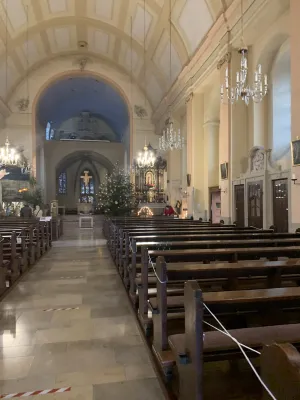
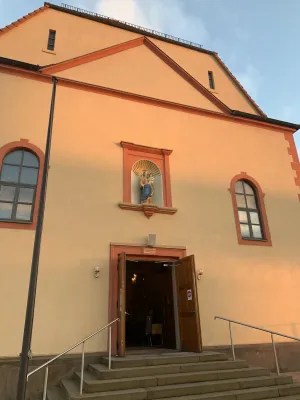
To this day, the pilgrimage church and monastery in Waghäusel attract pilgrims from all over the world. Waghäusel developed into a place of pilgrimage as early as the 15th century, and it all began with the legend of the shepherd. He and his flock of sheep were in danger when the Wagenbach stream flooded. Suddenly, he heard a woman’s voice guiding him to a safe place with a large oak tree. In the hollow trunk of the oak tree, he discovered a statue of the Virgin Mary with a child in her arms, which he took home with him. But time and again, the statue of Mary mysteriously disappeared from his house, and each time he found it in the hollow oak trunk. He then built a small house for the statue and placed it in the tree. The shrine quickly became a place of pilgrimage, as the statue of Mary was said to have miraculous powers. Due to the many pilgrims who visited the statue of Mary every day, in 1472 the Bishop of Speyer, Matthias von Rammung, built a Gothic chapel with a tower-like extension for a hermit who looked after the pilgrims and the chapel. Parts of this chapel can still be seen today in the choir of the church. In the 17th century, Bishop Philipp Christoph von Sötern of Speyer granted permission to found a monastery, which was added to the church. The Capuchins took over the pastoral care and supervision of the pilgrimage. After the monastery was dissolved in the 19th century, most of it was demolished. In 1920, the Capuchins returned. However, the church fell victim to a fire and only the Gothic chapel and the image of Mary remained intact. The church also suffered severe damage during the Second World War. In 1999, the church and monastery were taken over by the Brothers of the Common Life, who extensively renovated the buildings in 1999 and between 2002 and 2004. Since then, the buildings have been shining in new splendor. During my visit to the pilgrimage church, I discovered the late Baroque Mother of God with Child above the western entrance portal. An early Baroque copy of the image of Mary and an inscription plaque for the founder of the first monastery, Caspar Baumberger, are attached to the outer choir corner pillar. The pilgrimage church “Mother with the Kind Heart” and the monastery still bear witness to the history of the Marian pilgrimage and have become an important place of refuge for many people, especially in times of Corona, to recharge their batteries. Not far from the pilgrimage church and the monastery is the beautiful Hermitage, a Baroque hunting lodge and pleasure palace built by Prince-Bishop Damian Hugo von Schönborn in 1724, which I also visited on this occasion.








Post Comment