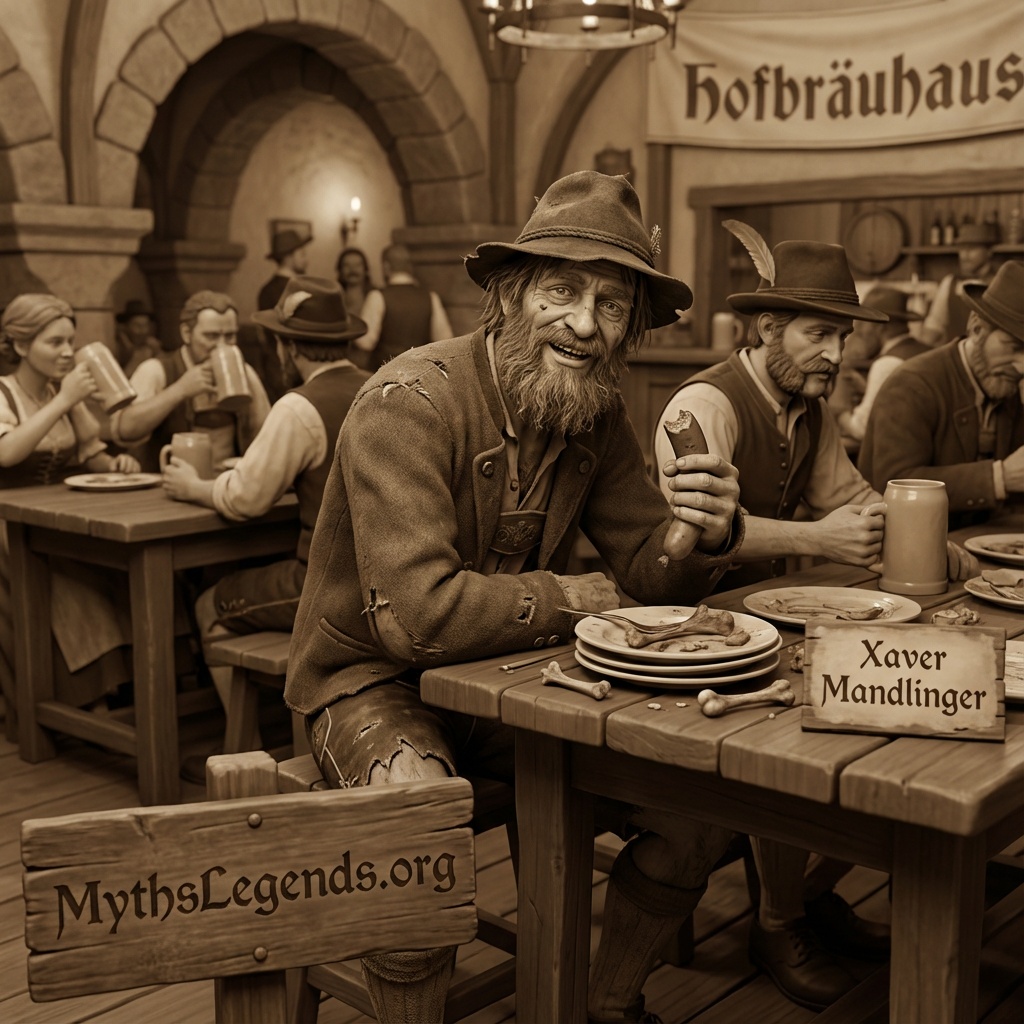
Munich’s Xaver Mandlinger, better known as the Hofbräuhaus Lenbach
In the vibrant city of Munich, where tradition and conviviality are paramount, the biography of Xaver Mandlinger, also known as the “Hofbräuhaus Lenbach,” tells a story that is as bizarre as it is tragic. Born in 1868, Mandlinger was an unforgettable figure at the legendary Hofbräuhaus, the most famous brewery in the world, which was once built by Wilhelm V, Duke of Bavaria, so that he would no longer have to fetch beer from Einbeck. To this day, the Hofbräuhaus is not only synonymous with cozy beer evenings and Bavarian conviviality, but it is also a major tourist attraction that was once the second home of Xaver Mandlinger. A man whose life was marked by unconventional views, a deep connection to gastronomy, and tragic twists and turns. Born in a time of change, the young Mandlinger was drawn to the Hofbräuhaus from an early age. Although he was talented at drawing and worked as the “house portraitist,” he lived a life that many would find incomprehensible. His drawings, which often vividly captured guests and scenes from the tavern, provided him with a certain income. But Mandlinger had developed his own unique philosophy of life. He fed himself on the guests’ leftovers, as he was firmly convinced that only the enjoyable consumption of leftover veal shanks and sausage skins kept him truly healthy. The people of Munich were always fascinated by Mandlinger. His unconventional life was a topic of conversation in the city. While others went home, he often stayed at the Hofbräuhaus, surrounded by exuberant celebrations, cheerful songs, and the smell of freshly tapped beer. He was the secret face of the Hofbräuhaus. Everyone knew the scrawny man who was always ready with his pen to capture the atmosphere in whimsical pictures, which is why his nickname refers to the Munich painter Franz Lenbach, who had a Tuscan villa, the so-called “Lenbach House,” built not far from the Hofbräuhaus in the 19th century. Xaver Mandlinger’s residence on the second floor of Rumfordstraße 8 became a place full of stories and memories that neighbors exchanged about him. Mandlinger himself seemed to be a storyteller. He never had a problem making people around him laugh with his witty manner. In October 1933, however, Xaver Mandlinger’s life took an abrupt turn. One night, he was robbed at the Hofbräuhaus, and a hefty 1,100 marks were stolen from him. The news spread like wildfire among the people of Munich, and it was hard to imagine that one of the establishment’s most esteemed guests had been affected. Contrary to all expectations, a large part of the stolen money reappeared soon after. Was it the courageous efforts of the police? Or perhaps even the insatiability of the tavern visitors, who secretly wanted to clear their consciences? Always loved by the people of Munich, Mandlinger received a little more affection and sympathy after this incident. But fate had even more in store for the Hofbräuhaus Lenbach. With the outbreak of World War II, things took a dramatic turn. The air war and the bombing of the city took their toll. When the Hofbräuhaus was finally almost completely destroyed by bombing on January 30, 1945, Mandlinger lost not only his job, but also the place that was more than just a restaurant to him—it was his home, his refuge. “Now that they’ve taken away my livelihood, I have nothing left to lose in this world…,” he summed up resignedly, as if he had come to terms with the inevitable end. These words illustrated the despair and sadness that now accompanied him. Shortly thereafter, on April 4, 1945, Xaver Mandlinger died in Munich at the age of 77. His death came shortly before the end of the war and marked the definitive end of an era – not only for Mandlinger himself, but also for what the Hofbräuhaus symbolized. The world had changed, and with it, the stories of days gone by had been pushed into the shadows. Xaver Mandlinger will forever be remembered as a character who brought the Hofbräuhaus to life. As the “Hofbräuhaus Lenbach,” he was more than just a guest or an artist. He was the spirit of Bavarian conviviality and the good life, a man who appreciated the small joys of everyday life in the midst of wartime. His quirky lifestyle and wisdom are an integral part of Munich’s stories, which are still told today by the older generations. The story of Xaver Mandlinger reminds us that no matter how challenging life may be, there is always room for humor, creativity, and human connection. Even though his life was marked by poverty and the hardships of war, the image of the cheerful, unshakeable man who fed himself on the leftovers of others and yet always lived with a smile remains alive in the hearts of Munich’s residents. Hofbräuhaus Lenbach will go down in history not only as a legendary figure, but also as a symbol of resilience and humor in difficult times, which connects us all.









Post Comment